“How much is this going to cost me?”
It’s the first question almost every homeowner asks when they suspect a hidden water leak, and it’s also the question that’s hardest to answer with a single number. Unlike a service with a fixed menu price, professional leak detection pricing depends on a genuine set of variables: where the suspected leak is, what kind of structure it’s hiding in, and how much investigative work is required before a technician can say “here it is” with confidence.
That uncertainty causes a lot of homeowners to delay calling, which is exactly the wrong response, because the cost of detection is almost always smaller than the cost of letting an undetected leak keep running. Here’s an honest breakdown of what drives leak detection pricing in Washington, what you’re actually paying for, and why the investment pays for itself faster than most people expect.
Why There’s No Single Price for Leak Detection
A plumber quoting a faucet replacement can give you a number over the phone. A leak detection technician generally can’t, and that’s not evasiveness, it’s accuracy. Before any equipment goes out, a legitimate detection company needs to know what they’re dealing with.
A slow leak in an easily accessible irrigation line is a fundamentally different job than a suspected slab leak under a finished basement floor, or an underground supply line leak somewhere along fifty feet of buried pipe between the meter and the house. Each of these requires different equipment, different access considerations, and different amounts of technician time, which is why responsible companies quote based on the specifics of your situation rather than a flat rate that doesn’t reflect the actual work involved.
The Main Factors That Drive Detection Pricing
Type and location of the suspected leak. A leak in an exposed crawl space pipe is typically faster and less expensive to locate than a leak embedded in a concrete slab, behind finished drywall, or buried several feet underground. The deeper or more enclosed the suspected leak, the more specialized equipment and time the job requires.
Property size and plumbing complexity. A small single-story home with straightforward plumbing runs is a simpler investigation than a large property, a home with multiple additions built in different decades, or a property with an irrigation system, pool, or detached structures that each have their own supply lines.
Accessibility. Finished basements, mature landscaping over buried lines, and crawl spaces with limited clearance all add time to a job compared to open, easily reached areas. This is one of the most underestimated cost factors, two homes with an identical leak can have very different detection costs purely based on how hard it is to physically get to the suspected area.
Urgency and scheduling. Emergency or same-day service, particularly outside standard business hours, typically carries a different rate structure than a scheduled appointment during normal hours.
Equipment required. Acoustic detection, pressure decay testing, and thermal imaging each serve different diagnostic purposes, and a job that requires multiple methods to confirm a finding will reflect that additional diagnostic work.
What You’re Actually Paying For
It helps to understand what a detection fee covers, because it isn’t just “someone showing up with a tool.”
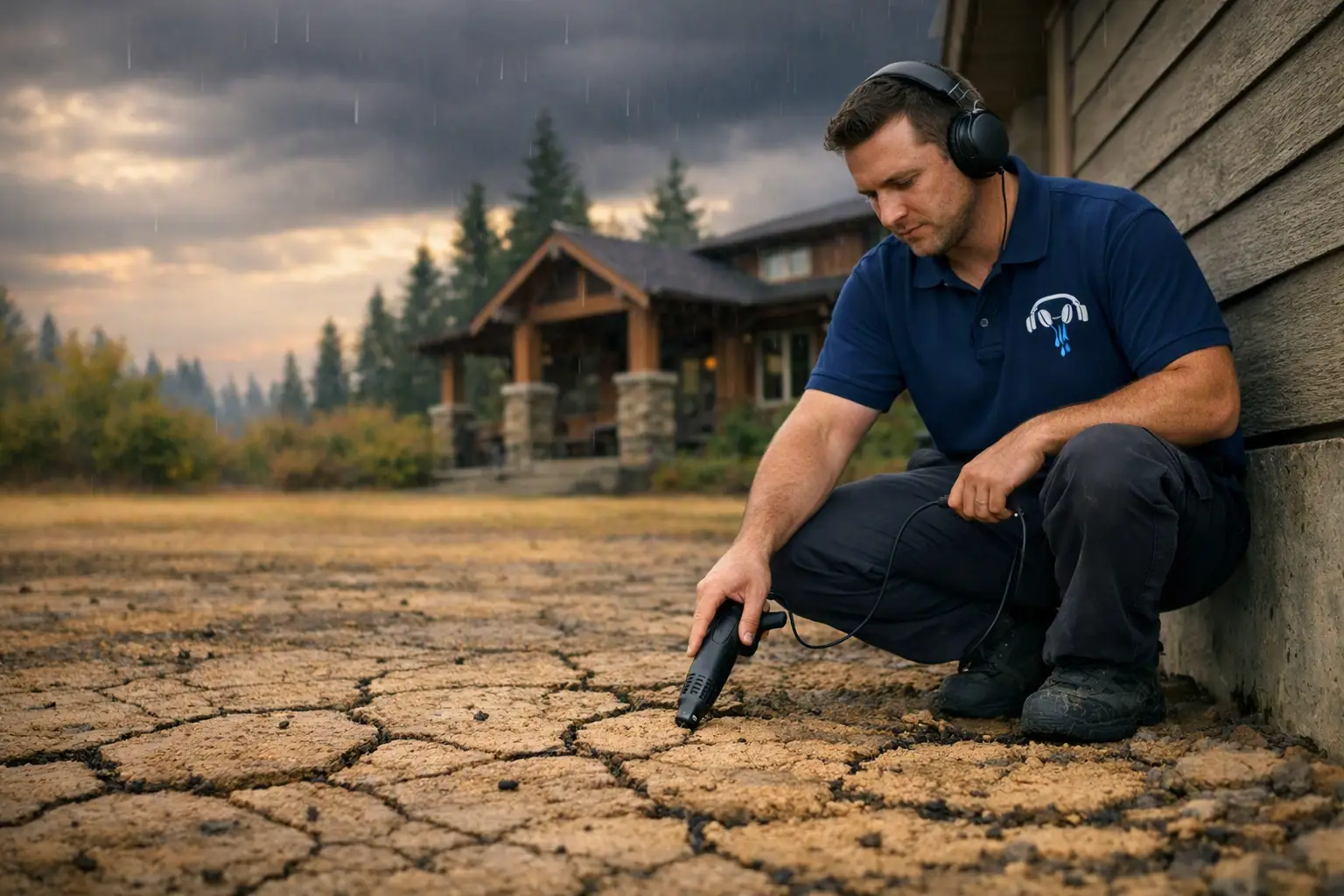
A professional non-invasive leak detection visit typically includes: an initial consultation to understand your water usage patterns and symptoms, pressure testing to isolate which plumbing system or zone contains the leak, acoustic listening equipment to pinpoint the specific location along a pipe run, and in many cases thermal imaging to visually confirm a moisture anomaly before any repair work begins.
The entire purpose of this process is to avoid the alternative: guesswork. A technician, or a homeowner, without proper detection equipment is left with two options when a leak is suspected but not visible: open up walls, cut into slabs, or excavate landscaping speculatively, or call in equipment that can confirm the exact location first. The Standards of Practice that govern home inspections explicitly limit general inspectors to visual, non-invasive examination, which is precisely why a specialized detection visit exists as a separate service. You’re not paying for a guess. You’re paying to skip the guessing entirely.
The Real Comparison: Detection Cost vs. The Cost of Doing Nothing
This is where the math becomes clear.
The average American household loses nearly 10,000 gallons of water every year to leaks, and that’s the EPA’s estimate for typical household leaks, before accounting for the kind of leak large enough to trigger a homeowner’s concern in the first place. A leak as small as one-eighth of an inch can waste over 250 gallons of water a day, which on a typical Washington municipal water rate adds up quickly even before any structural damage enters the picture.
And the water bill is usually the smallest part of the cost. An undetected leak that’s been running against a slab, inside a wall cavity, or through a crawl space long enough can produce: wood moisture content sufficient for decay fungi to establish in framing, saturated insulation that has to be replaced rather than dried, and in the more severe cases, mold remediation costs that run into the thousands. None of this is hypothetical, it’s the standard progression of what happens when a leak is allowed to run for months instead of being located and stopped in days.
There’s also an insurance dimension worth knowing about before you need it. As we’ve covered in detail elsewhere on this site, most homeowner’s insurance policies treat gradual, undetected leaks differently than sudden plumbing failures, and a delayed discovery can directly affect whether a claim is covered at all. Acting early isn’t just about minimizing damage. It can be the difference between a covered claim and an out-of-pocket repair.
Why Western Washington’s Conditions Affect the Equation
Local conditions matter here too. Washington’s clay-heavy soils and naturally high seasonal groundwater tables mean that underground leaks don’t drain away or evaporate the way they might in a drier climate, water from a leak tends to accumulate and migrate, which is part of why catching a leak early matters more here than it might in a different region. It’s also why local utilities and the Washington State Department of Health’s drinking water program emphasize leak awareness as part of responsible water system management, the same factors that make leaks expensive for a homeowner are the ones that make unaccounted water loss a system-wide concern for municipal providers.
How to Get an Accurate Quote, Not a Guess
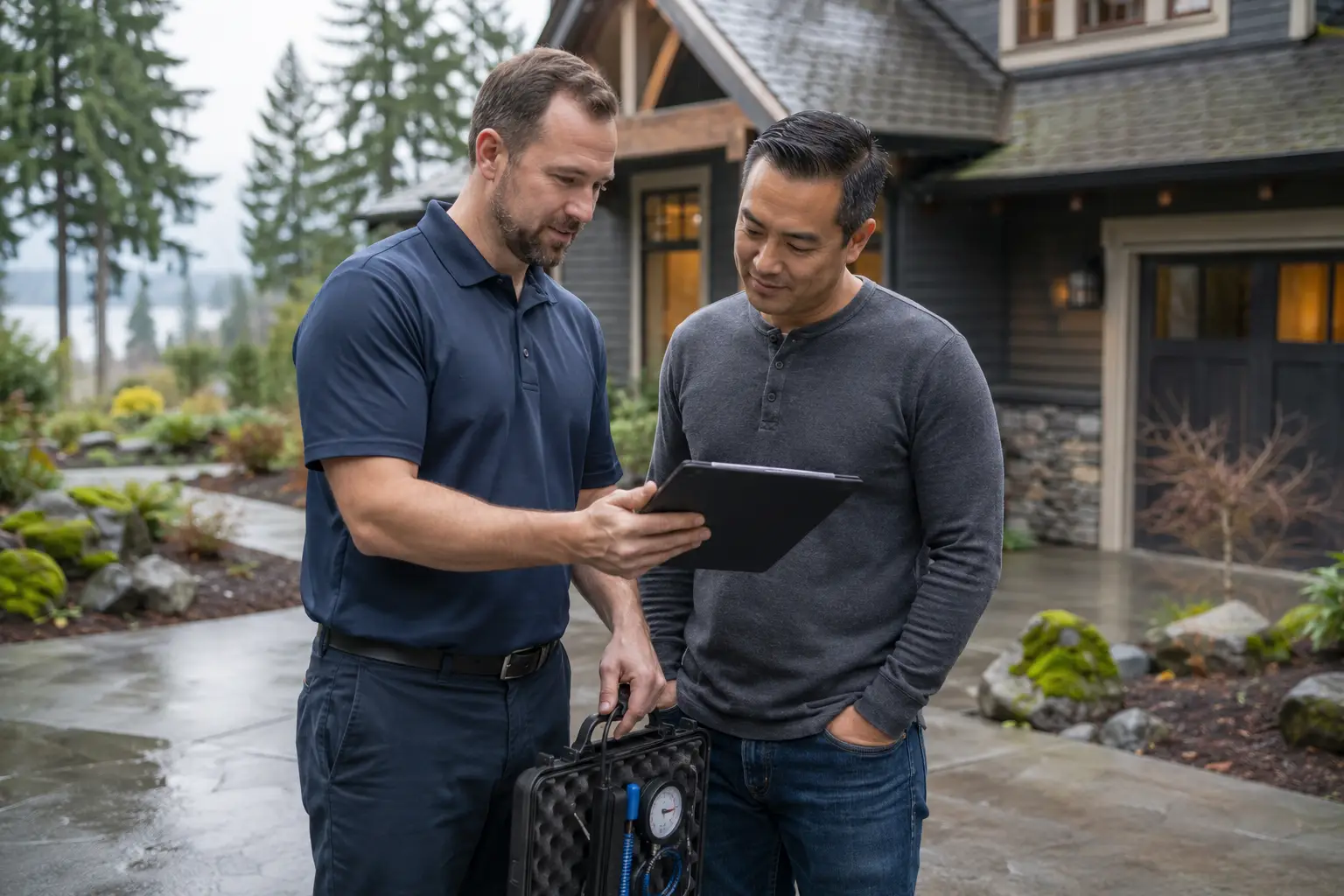
Because pricing depends so heavily on the specifics of your situation, the most useful thing you can do before calling is gather a little information: how you noticed the issue (water bill increase, visible moisture, sound of running water, declining water pressure), roughly how long you’ve suspected something is wrong, and whether the concern is tied to a specific area of the property, a slab, a crawl space, a pool, or an irrigation system.
A company that gives you a real number is one that asks questions first. If a company quotes a flat detection price over the phone without knowing anything about your property, that’s worth treating with some skepticism, it usually means the price isn’t built around your actual situation.
Know the Cost Before It Grows
The honest answer to “what does this cost?” is: less than you’d expect, and significantly less than the alternative. A professional leak detection visit is a bounded, predictable expense. An undetected leak is not, it’s a cost that compounds every week it continues, in water waste, in structural damage, and potentially in your ability to file an insurance claim at all.
If you suspect a leak anywhere on your property in King, Snohomish, Skagit, Whatcom, Island, or San Juan County, the fastest way to get an accurate, situation-specific quote is to talk to someone who can ask the right questions, call Action Leak Detection at (360) 922-8829.
We’ll walk through what you’re seeing, explain what detection method fits your situation, and give you a real number before any work begins. No guesswork, no exploratory demolition, and no surprises.
The leak isn’t getting cheaper to find by waiting.
Action Leak Detection serves Whatcom, Skagit, Snohomish, King, Island, and San Juan counties. We answer 24/7, including weekends and holidays.