Every Washington homeowner knows the feeling of the first real rain after a long dry summer. The air changes, the dust settles, and the ground finally gets a drink after months of going without. It feels like relief.
For your home’s plumbing, though, that transition is one of the most stressful moments of the year. The swing from bone-dry ground back to saturated soil doesn’t happen gently. It happens fast, and it happens unevenly, and it works directly against the pipes and foundation that spent all summer adjusting to dry conditions. This is why the tail end of a dry summer, right before the rains return, is quietly one of the peak windows for hidden leaks to develop or finally reveal themselves. After a fourth straight drought year in Washington, this fall’s transition is worth paying attention to. Here’s what’s happening underground, and why now is the smart time to check.
What a Dry Summer Did to the Ground Under Your Home
To understand why the return of the rain is such a pressure point, you have to start with what the summer already did.
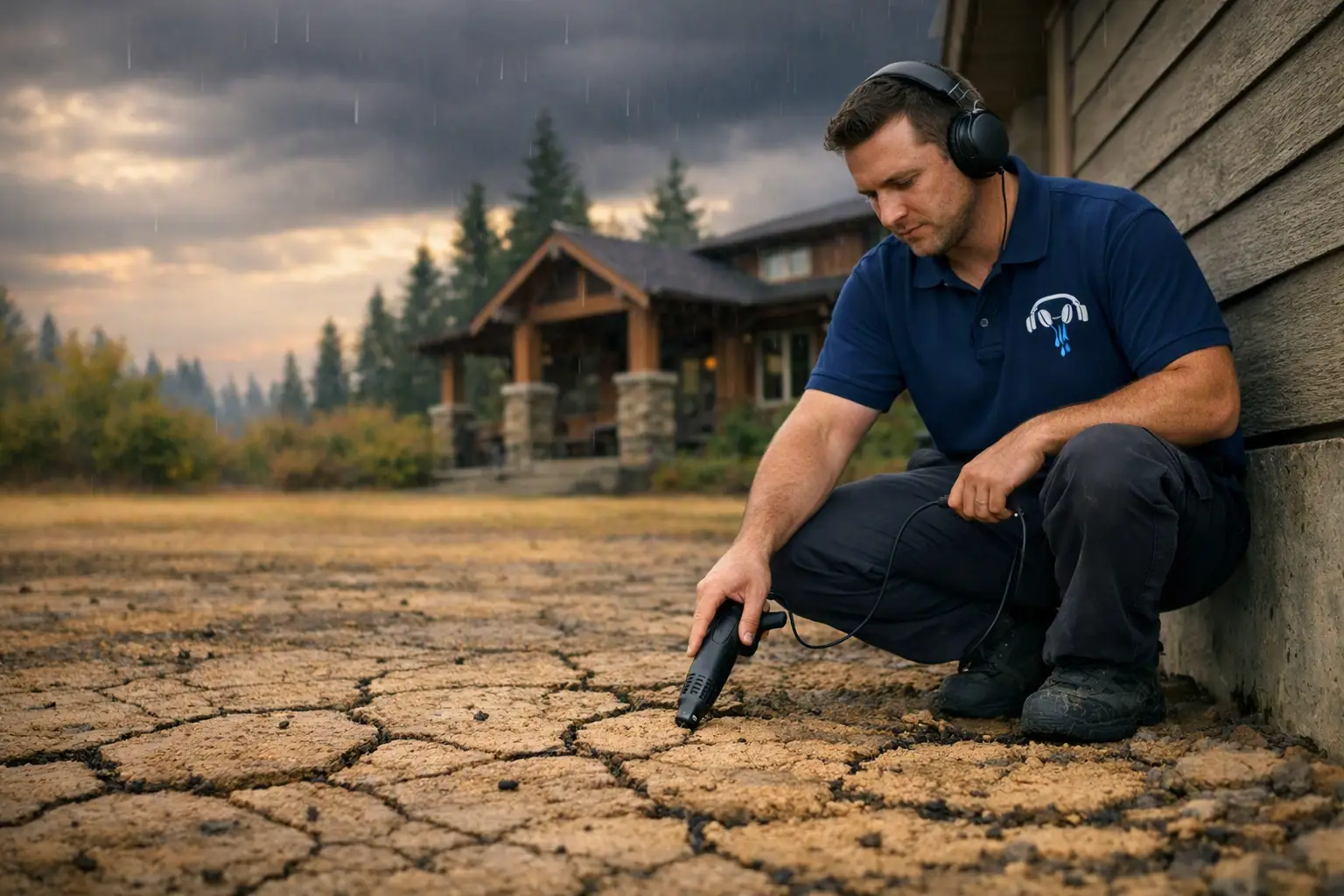
Over a long dry stretch, moisture is pulled out of the soil, and clay-rich ground responds by shrinking. As we covered in our look at how a dry summer triggers slab leaks, that contraction pulls the soil away from foundations and the pipes buried in it, opening small voids and letting slabs settle unevenly. By the end of summer, the ground beneath many homes is drier, more cracked, and more mobile than it was in spring.
Critically, those dry cracks in the clay become direct pathways for water to travel deep into the ground the moment it rains. The summer didn’t just dry the soil out. It built a network of channels that the first heavy rains will race straight down into. The stage is set before a single drop falls.
Why the First Rains Hit So Hard
When the rain finally arrives, the clay does the opposite of what it did all summer: it swells. And it doesn’t do it slowly or evenly.
As clay soils absorb moisture from heavy rainfall, they expand rapidly, and because the water reaches some areas faster than others through those summer cracks, the expansion is uneven. One section of ground swells and lifts while an adjacent section is still catching up. The foundation heaves up in the wet season and settles in the dry months, and both directions of that movement stress a rigid concrete slab that isn’t built to flex.
Now think about the pipes locked into that slab and running through that soil. All summer they were dragged down as the ground shrank. Now they’re shoved back the other way as it swells, and unevenly at that. A pipe joint that was stressed but holding through the dry months can be the thing that finally gives when the ground heaves in October. The leak didn’t start with the rain exactly, but the rain is what pushed an already-stressed pipe past its limit.
There’s a second effect, too. Those voids that opened under the slab in summer don’t just close politely. They can fill with rainwater and exert hydrostatic pressure against the foundation, adding water load to ground that’s already moving.
The Leaks That Were Hiding All Along
Not every leak this season is brand new. Some have been running quietly all summer, and the change of season is simply what makes them visible.
In a dry summer, a slow underground leak can be masked. The parched soil drinks the water as fast as it escapes, so there’s no telltale wet patch, no soft ground, no obvious sign at the surface. The leak is there, wasting water and undermining the soil, but it stays hidden because the thirsty ground hides the evidence. A leak the size of a small crack can waste over 250 gallons of water a day while giving almost nothing away on the surface.
Then the rains come, the ground saturates, and it can no longer absorb the extra water from the leak on top of the rainfall. Suddenly the wet spots appear, the crawl space shows moisture, the soggy patch by the foundation won’t dry. Homeowners often assume the leak just started. In many cases it’s been running for months, and the wet season only pulled back the curtain.
Why This Matters More in Western Washington
Our region makes this seasonal swing more pronounced than most. Much of western Washington sits on clay-heavy soils with high seasonal water tables, ground that spends most of the year wet and expanded. A drought summer forces that soil to dry and shrink harder than it’s accustomed to, which means the return to saturation in fall is a bigger, faster change in volume than a home in a naturally arid climate would ever see.
That larger swing means more movement, and more movement means more stress on slabs and buried pipes. Add our genuinely wet autumns, where the ground doesn’t just moisten but fully saturates and stays that way for months, and you have a recipe for leaks that appear right as the season turns and then get fed steadily through the wet months.
The Case for Checking Now, Not Later
The window before the rains fully arrive is the ideal time to get ahead of all this, for a simple reason: a leak is far easier and cheaper to deal with as a small dry-season problem than as an active wet-season one.
A few things worth doing as summer winds down:
- Watch your water bill and meter. A bill that’s crept up over the summer, or a water meter that moves when everything’s shut off, is the clearest early signal of a hidden leak that the wet season is about to worsen.
- Look for new cracks or sticking doors. Foundation cracks, or doors and windows that suddenly stick, are signs the ground has been moving your home over the summer.
- Clear your gutters and check your grading. Directing roof runoff away from the foundation with working gutters and proper slope is one of the most effective ways to reduce the uneven soaking that stresses your slab when the rains hit.
- Get a suspected leak located before fall. If anything has seemed off this summer, finding and fixing it now means it isn’t sitting there waiting for saturated ground to make it worse.
If you’d like to understand what a professional detection visit involves, our post on why slab leak detection protects your foundation walks through the approach.
Get Ahead of the Season Before It Gets Ahead of You
The change from dry summer to wet fall is beautiful above ground and turbulent below it. The soil heaves, the pipes strain, and leaks that hid all summer choose this moment to appear. Catching them in the calm window before the rains fully arrive is the difference between a quick repair and a wet-season problem that compounds for months.
If your water bill climbed this summer, you’ve spotted new cracks, or something about the house just seems off heading into fall, don’t wait for the rain to force the issue. Call Action Leak Detection at (360) 922-8829. We locate hidden slab, underground, and supply-line leaks precisely and non-invasively for homeowners throughout King, Snohomish, Skagit, Whatcom, Island, and San Juan counties.
The rains are coming either way. Let’s make sure your pipes are ready for them.
Action Leak Detection serves Whatcom, Skagit, Snohomish, King, Island, and San Juan counties. We answer 24/7, including weekends and holidays.