You’ve run the bucket test, the auto-fill won’t quit, or the ground near the deck stays soggy on a dry week. You’re now fairly sure your pool is leaking. So you do the sensible thing and start looking for someone to find it, and almost immediately a few uneasy questions show up.
Are they going to drain my pool? Will they jackhammer the deck to “have a look”? How do they even find a leak in something that holds 20,000 gallons of water and runs through pipes buried under concrete?
These are good questions, and the honest answers are reassuring. Modern pool leak detection is a methodical diagnostic process, not a demolition project. A skilled technician can usually pinpoint exactly where your pool is losing water, often down to a single fitting or a specific length of buried pipe, without draining the pool and without breaking up your deck. Here’s what that process actually looks like, so you know what you’re paying for and what to expect before anyone arrives.
First, the Question Everyone Asks: “Do You Have to Drain My Pool?”
Almost always, no. This is the single biggest misconception about pool leak detection, and it stops a lot of owners from calling sooner than they should.
The whole point of professional detection equipment is to find a leak while the pool is full and operating normally, because a full pool is what makes several of the key tests possible in the first place. Draining a pool to “look for the crack” is slow, expensive, wastes thousands of gallons, and frequently doesn’t even reveal the problem, since a hairline crack or a failing pipe joint can be invisible to the naked eye even on a bare surface.
There’s also a real structural reason not to drain a pool in our region, which we’ll come back to: in western Washington’s high groundwater conditions, an empty pool can actually be the more dangerous state to be in. A good technician drains a pool only as a genuine last resort for a specific, hard-to-reach leak type, not as a starting point.
Step One: Confirming the Leak and Narrowing the Zone
Before any specialized equipment comes out, a technician starts the same way a good doctor does, by listening and observing. The goal of this first stage is to confirm the leak is real and to narrow down where it’s most likely hiding, because pool leaks fall into a few distinct categories and each one is found a different way.
A leak lives in one of three places: the structure (cracks or gaps in the shell, vinyl liner, or plaster), the fittings (where skimmers, return jets, lights, and main drains connect to the shell), or the buried plumbing (the supply and return lines running between the pool and the equipment pad). We cover the symptoms that point to each of these in detail in our guide to the five signs your pool has a leak.
A technician uses early clues to decide where to focus. Does the water drop stop at a certain level, such as the skimmer mouth or the light? That points toward a fitting at that depth. Do air bubbles appear in the return jets? That points to the suction-side plumbing. Does the loss change when the pump is running versus off? That helps separate a structural leak from a pressure-side plumbing leak. This reasoning is what turns a 20,000-gallon mystery into a short list of specific things to test.
Dye Testing: Finding Leaks in the Shell and Fittings
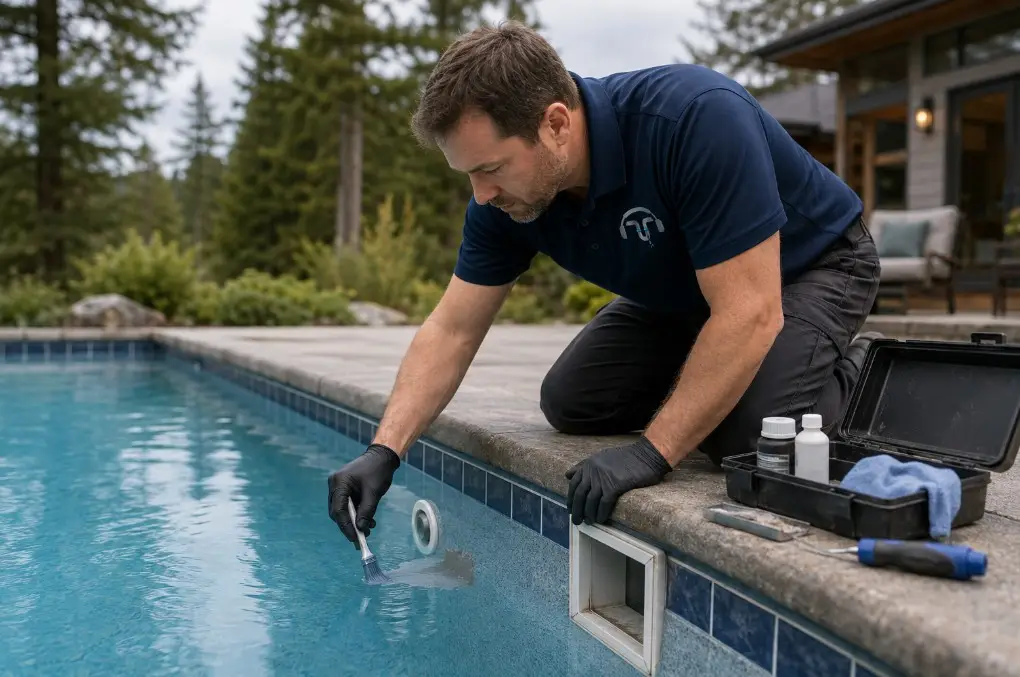
For leaks in the pool structure or its fittings, one of the most precise tools is also one of the simplest: dye.
With the pump off and the water held perfectly still, the technician releases a fine stream of colored test dye right next to a suspected leak point, a crack in the plaster, the seam around a light niche, the edge of a skimmer throat, or a vinyl liner seam. Water leaving the pool through a leak creates a tiny current, even an extremely slow one. If there’s a leak there, the dye gets pulled into it and disappears into the crack or gap, showing the technician the exact spot where water is escaping.
It sounds low-tech, and that’s exactly why it’s so reliable. There are no false readings to interpret. The dye either gets drawn into a void or it doesn’t. For shell cracks and fitting failures, which are among the most common pool leaks, especially in older pools where fittings have had years to loosen, dye testing confirms the precise location so the repair targets the actual problem instead of a guess.
Pressure Testing: Isolating the Buried Plumbing
When the leak is in the underground plumbing rather than the pool itself, dye won’t help, because the leak isn’t in the pool, it’s somewhere along a pipe buried under the deck or the yard. This is where pressure testing comes in.
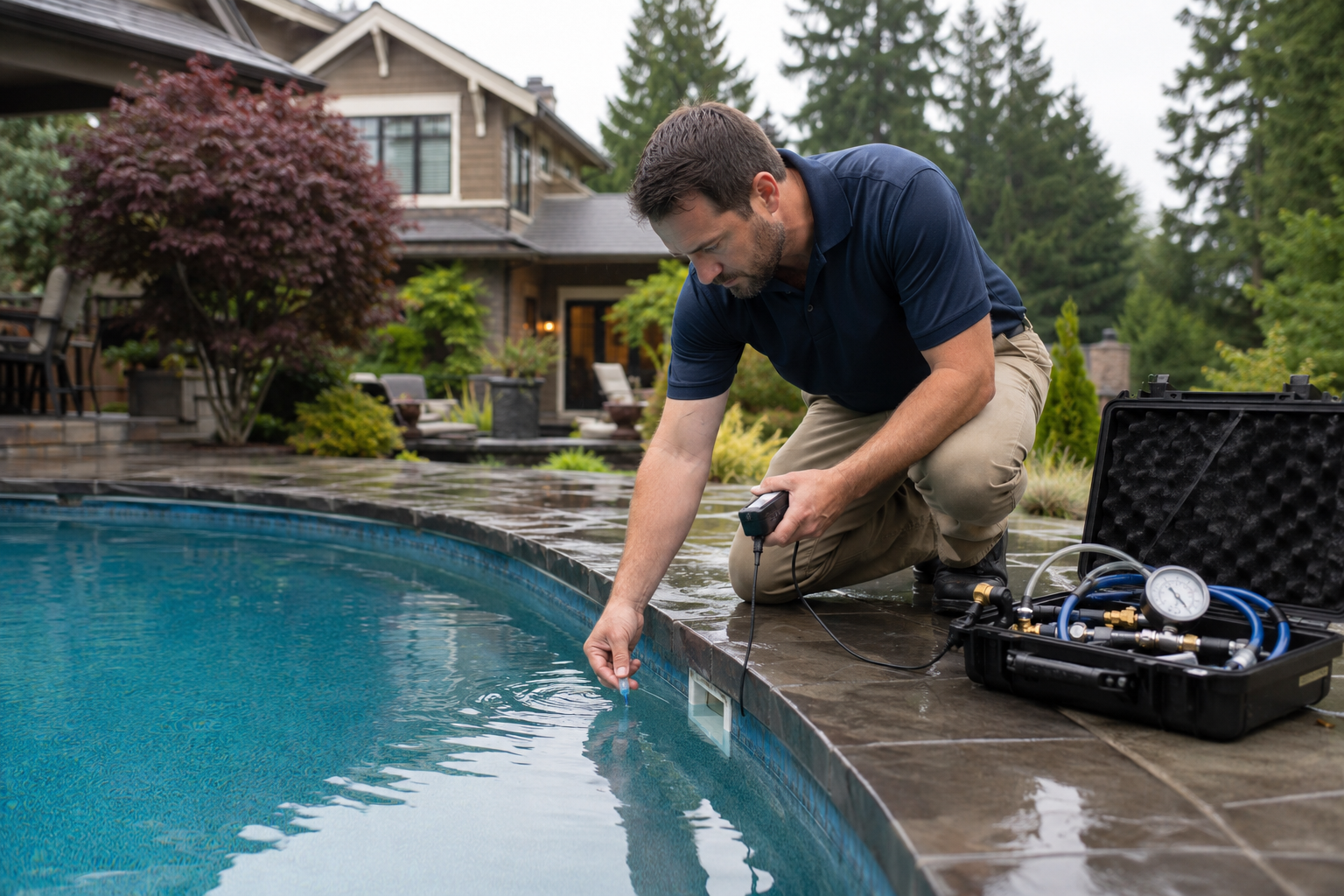
The technician seals off an individual line, one return, one suction line, one skimmer at a time, and pressurizes it with air or water to a controlled level, then watches a gauge. A line that holds pressure steadily is intact. A line that steadily loses pressure has a breach somewhere along its length. By testing each line separately, the technician identifies not just that there’s a plumbing leak, but which specific line it’s in, which is the difference between excavating a two-foot section and digging up an entire deck.
This is the test that depends on the pool being full and the system intact, and it’s the clearest example of why draining the pool first would actually work against you. The full, pressurized system is what reveals where the plumbing is failing.
Acoustic Listening and Hydrophones: Pinpointing the Exact Spot
Knowing which line is leaking narrows things down to a length of pipe. Pinpointing the precise spot to dig, so the repair is a small, targeted excavation instead of a trench, is the job of electronic listening equipment.
Water escaping from a pressurized pipe makes a sound, a faint hiss or rush at the point of the breach. Specialized ground microphones and underwater hydrophones are sensitive enough to pick up that sound through concrete, soil, and water, frequencies a human ear could never catch on its own. By moving the equipment along the suspected line and listening for where the sound is loudest, a technician can mark the leak location on the surface, often within inches of the actual break.
This acoustic step is what makes the whole process worth it. It’s the reason a professional can hand you an “X marks the spot” instead of a recommendation to start digging and hope. The repair crew opens one small area, fixes the pipe, and closes it back up, rather than tearing out decking across the whole run.
Why “Just Dig and Look” Is the Most Expensive Approach
It’s worth being clear about the alternative, because some pool owners are tempted to skip detection and have a handyman or general pool company start opening things up to find the leak directly.
The problem is that a pool leak is almost never where it appears to be. Water travels. A wet spot in the lawn might be ten feet from the actual break in the pipe. A crack you can see on the deck might have nothing to do with where water is escaping. Speculative excavation, draining the pool, cutting into the deck, or trenching the yard based on a guess, routinely means tearing up far more than necessary and still missing the leak, because the assumed location was wrong.
Professional detection exists precisely to eliminate that gamble. You pay for the diagnosis so that the repair, the expensive, disruptive part, is as small and accurate as it can possibly be. Spending a few hundred dollars to know exactly where to dig almost always costs less than the demolition and re-do of guessing.
Why Western Washington Makes Non-Invasive Detection Matter Even More
Our region adds two wrinkles that make the full-pool, non-invasive approach especially important.
First, groundwater. Much of western Washington sits on clay-heavy soils with naturally high seasonal water tables. When a pool is drained in those conditions, the water pressure in the saturated ground around and beneath the shell no longer has the weight of the pool water to push back against it. In the worst cases, that hydrostatic pressure can crack a pool floor or even lift the shell out of the ground, turning a small leak into a catastrophic structural failure. This is a major reason a responsible local technician avoids draining your pool unless there’s truly no alternative.
Second, the calendar. With only twelve to fourteen weeks of reliable warm weather, a Washington pool season has no time to waste on a slow, drain-and-inspect process or a dig-and-guess repair that has to be redone. Accurate detection the first time is what keeps a leak from eating half your summer.
What to Expect, and How to Prepare, When You Call
The more a technician knows before arriving, the faster the diagnosis goes. Before you call, it helps to have a few things in mind: how you first noticed the problem (water level, auto-fill, water bill, wet ground, air in the jets), roughly how fast the water is dropping if you’ve measured it, whether the loss seems different with the pump on versus off, and the rough age and type of your pool and equipment.
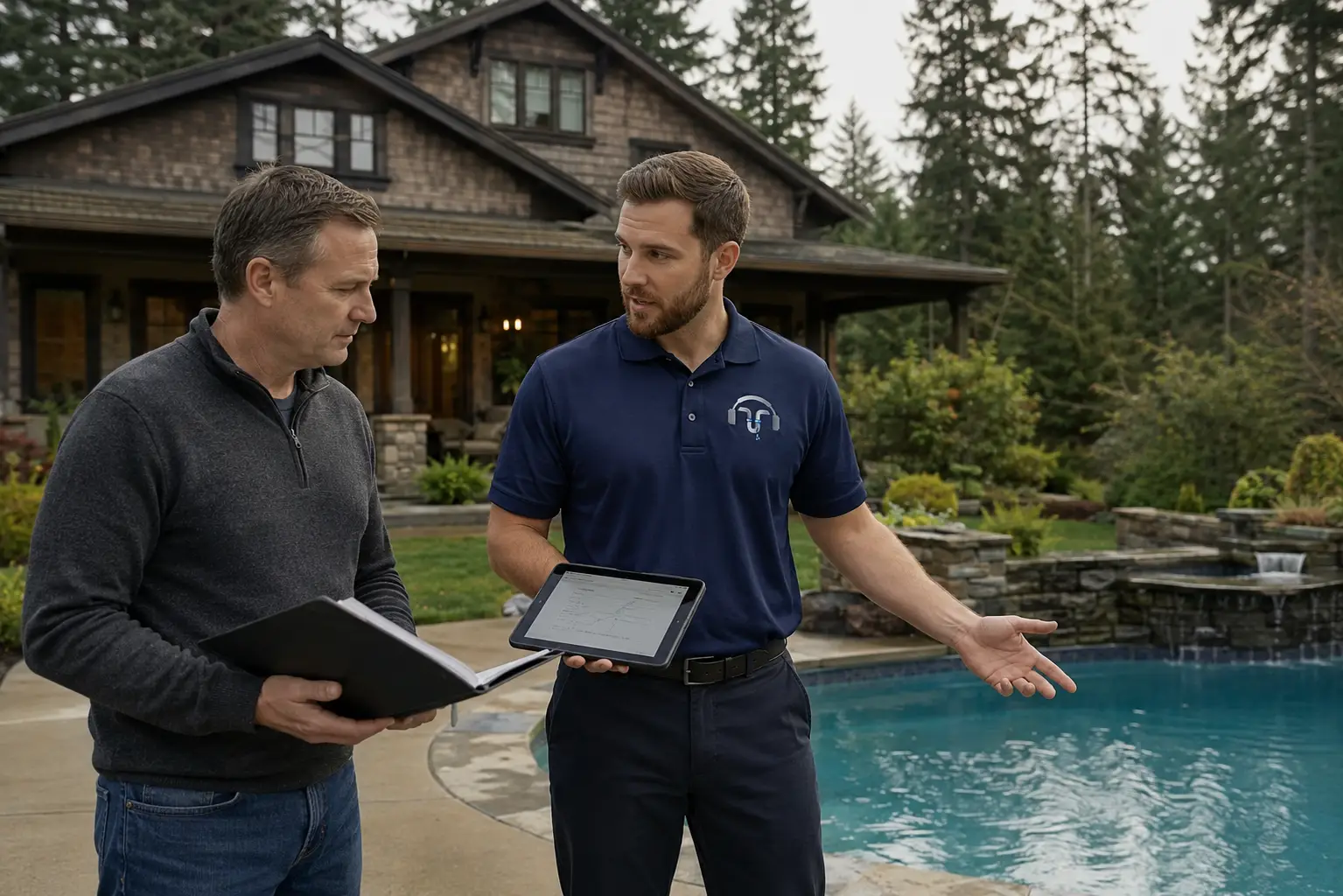
A typical detection visit is a matter of hours, not days. You’ll get a clear answer about where the leak is, what type it is, and what the repair involves, before any digging or repair work begins. No drained pool, no torn-up deck as a starting point, and no exploratory destruction.
That clarity is the entire value of calling a specialist. You’re not paying someone to come break things and look. You’re paying for the answer that makes the fix small.
Find the Leak Without Losing the Pool, or the Summer
A leaking pool feels like an overwhelming problem because the water disappears into places you can’t see. The reassuring reality is that finding it is a solved problem, handled by people who do it every day with dye, pressure gauges, and acoustic equipment, while your pool stays full and your deck stays intact.
If your pool is losing water and you want a real answer instead of a guess, call Action Leak Detection at (360) 922-8829. We locate pool leaks precisely, using non-invasive methods, for pool owners throughout King, Snohomish, Skagit, Whatcom, Island, and San Juan counties.
We’ll find exactly where your pool is leaking, so the repair is the small part, not the whole summer.
Action Leak Detection serves Whatcom, Skagit, Snohomish, King, Island, and San Juan counties. We answer 24/7, including weekends and holidays.