Most Washington homeowners never go into their crawl space.
That’s understandable. It’s dark, it’s low, it’s not somewhere you spend time voluntarily. But it’s also where a significant portion of your home’s water supply lines, drain connections, and structural framing live — and in the Pacific Northwest, it’s one of the most common places a hidden water leak quietly causes serious damage before anyone notices.
Western Washington’s combination of high annual rainfall, clay-heavy soils, naturally elevated groundwater tables, and older housing stock creates an environment where crawl space moisture problems are almost expected — and where a plumbing leak can hide for months under the guise of “normal Pacific Northwest dampness.” By the time visible damage appears above, the framing, insulation, vapor barrier, and pipes below have often been compromised for a long time.
Here’s how to read what your crawl space is actually telling you — and how to tell the difference between ambient moisture and an active plumbing leak.
Why Crawl Space Leaks Are Different From Other Hidden Leaks
A leak in a wall cavity or under a slab shows up in predictable ways — a water stain, a soft patch of flooring, a warm spot on the concrete. You can often narrow the source down by location alone.
A crawl space leak is harder to read because the environment is already wet.
Pacific Northwest crawl spaces are among the most moisture-challenged in the country. Rain infiltrates through foundation vents. Ground moisture migrates upward through soil. Condensation forms on cold pipes during temperature swings. All of this is happening regardless of whether there’s a plumbing leak — which means a leak can blend into the background for a very long time before anyone questions whether the moisture is coming from the wrong place.
The difference between ambient crawl space moisture and an active leak comes down to specific, identifiable signs. Each one tells you something different about what’s happening below your home.
Warning Sign #1: A Musty Smell That Persists Through Summer
A musty odor in the living space — especially near floor level, along baseboards, or in rooms above the crawl space — is one of the earliest signs that moisture below has crossed a threshold.
Mold requires four conditions to grow: a food source, the right temperature, oxygen, and moisture above 60% relative humidity. Wood framing, insulation, and the paper backing on older fiberglass batts all serve as food sources. Crawl spaces in western Washington routinely hit the humidity threshold during the wet season — but a crawl space that stays musty through July and August, when outdoor humidity drops and the rest of the house dries out, is telling you that a moisture source is actively keeping it wet.
Persistent summer mustiness is not a ventilation problem. It’s a water problem. The source may be ambient — poor drainage, inadequate vapor barrier — or it may be a slow plumbing leak feeding moisture into the space continuously. Both deserve investigation. Only one requires a leak detection call.
Warning Sign #2: What You See on the Vapor Barrier
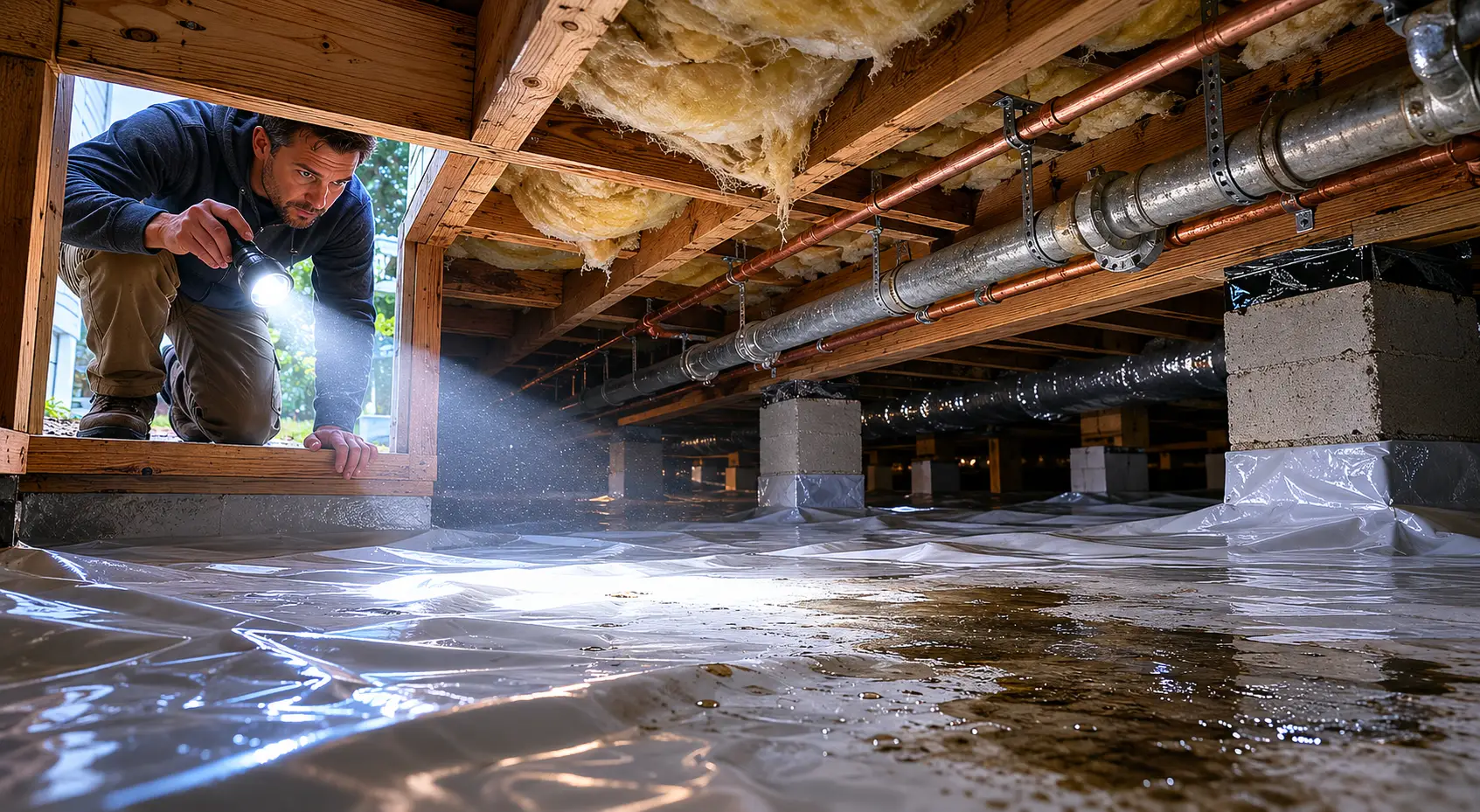
If you do go into your crawl space, the vapor barrier — the sheet of polyethylene film laid over the soil — is one of the most useful diagnostic surfaces in your home.
A vapor barrier in a healthy crawl space may show minor condensation after a wet winter, but it should be largely dry by mid-summer. Watch for:
- Standing water pooled on top of the barrier, especially in localized areas near pipe runs or the perimeter — this almost never happens from ambient moisture alone and usually indicates a source above or at the barrier level
- Dark staining or discoloration in patches, rather than uniformly across the whole barrier — a uniform gray tint is common from age; a distinct dark patch in one quadrant points to a localized moisture source
- Tears or voids in the barrier with wet, dark soil visible beneath — these are worth investigating, but aren’t necessarily a leak; however, if the soil directly beneath a void is significantly wetter than surrounding areas, something is actively saturating that spot
- White mineral deposits (efflorescence) on the barrier or on nearby concrete block — these are left behind when water evaporates repeatedly from the same location, which is a sign of consistent moisture movement, not just a single weather event
A properly installed vapor barrier should cover the entire soil surface with sealed overlapping seams, but in older Washington homes it’s common to find partial coverage, punctures from past work, or barriers that have shifted over years of settling. Any gap in coverage becomes a pathway for ground moisture — and any concentrated wet area near a gap deserves closer attention.
Warning Sign #3: Rust, Staining, or Corrosion on Pipe Fittings and Clamps
This is the sign that most directly points to an active plumbing leak rather than ambient moisture.
Pipe hangers, clamps, and metal fittings in a crawl space will develop surface rust over time — that’s normal in the Pacific Northwest. What’s not normal is concentrated rust staining directly below a fitting, a joint, or a connection point, combined with mineral deposits or a visible white or greenish crust on the pipe itself.
Look specifically at:
- Galvanized steel supply lines, still present in many homes built before the 1980s. Galvanized pipe has a typical lifespan of 40 to 70 years — and it corrodes from the inside out, meaning the exterior may look intact while the interior has narrowed significantly and the walls have thinned to the point of pinhole failure. A weeping galvanized joint often appears as a white or rust-colored mineral crust at the threaded connection.
- Copper supply lines, which can develop pitting corrosion from aggressive water chemistry. Pitting appears as small green or blue-green spots on the pipe surface, sometimes with a crust of copper carbonate. Any green staining on copper in a crawl space warrants a close look.
- Plastic push-fit and CPVC fittings in homes from the 1980s through 2000s. These don’t rust, but look for a white mineral ring around the fitting connection — water that has been weeping and evaporating leaves these deposits behind.
Any fitting or joint with localized staining that differs significantly from the rest of the pipe run — especially combined with moisture on the vapor barrier directly below — should be treated as a potential active leak until a pressure test confirms otherwise.
Warning Sign #4: Soft Floors, Springy Subfloor, or Warped Hardwood Above
When moisture from a crawl space leak reaches the wood framing and subfloor, the first sign above is usually a subtle change in how the floor feels underfoot.
A subfloor that has been absorbing moisture from below will feel slightly springy or spongy — not dramatically weak, but softer than it should be, especially near walls or in areas directly above the pipe runs. Hardwood floors may show cupping (edges higher than the center of each plank) or crowning (center higher than the edges) as moisture content in the wood shifts unevenly.
Wood decay fungi require wood moisture content above 19 to 30 percent to establish and grow. Once decay begins, it weakens structural members far faster than the visible surface damage suggests. A joist that looks intact from below may have lost a significant portion of its load-bearing capacity in its core.
In western Washington, where wood-framed construction is nearly universal and crawl space framing is directly exposed to the environment, catching subfloor moisture before decay sets in is the difference between a plumbing repair and a structural repair. The two are not in the same cost category.
Warning Sign #5: Insulation Falling, Sagging, or Discolored From Below
Crawl space insulation — typically fiberglass batts hung between floor joists — is one of the first casualties of a hidden leak.
Fiberglass insulation loses up to 40% of its thermal effectiveness when wet, and once it absorbs moisture it holds it, keeping the framing above it damp long after the original source is addressed. Wet insulation also becomes significantly heavier, causing batts to sag and fall away from the subfloor — which is why dropped or sagging insulation in a crawl space is one of the most visible early indicators of a moisture problem.
Look for:
- Batts that have dropped completely from between joists, lying on the vapor barrier
- Insulation with a dark, compressed appearance instead of the normal fluffy texture
- Visible mold growth on the facing of the insulation batts — mold on building materials typically appears within 24 to 48 hours of sustained wet conditions
Replacing insulation without identifying and fixing the underlying moisture source is a temporary measure. The new insulation will follow the same path.
The Misattribution Problem: Why Crawl Space Leaks Get Blamed on Drainage
Here’s where Washington homeowners lose the most time and money.
Because crawl space moisture is so common in the Pacific Northwest, and because drainage and grading issues are legitimate contributors to that moisture, many homeowners — and even some contractors — default to drainage as the explanation for every crawl space moisture problem. Gutters get extended. French drains get installed. Vapor barriers get replaced.
The leak keeps running.
A plumbing leak in a crawl space does not behave like a drainage problem. It is consistent regardless of weather. It is localized to pipe runs and connection points rather than spread uniformly across the perimeter. It persists through dry summers when groundwater drops and drainage issues resolve on their own. And it shows up on a pressure test in a way that no amount of regrading will ever fix.
If your crawl space moisture problem has not responded to drainage improvements — or if it developed or worsened during a dry summer when you wouldn’t expect groundwater or rain infiltration — the explanation is almost certainly upstream of the foundation, not outside it.
What Washington Homeowners Should Do
You don’t need to spend time in your crawl space to start gathering information.
Start here:
- Check your water meter at night. Turn off every fixture, note the reading, and check it in an hour. Any movement means water is going somewhere. A crawl space plumbing leak will show on the meter the same way any other leak does — it’s just harder to spot because the evidence isn’t visible from inside the house.
- Pull your last 12 months of water bills. A slow creep — even $8 to $12 per month over several billing cycles — is often the first financial signal of a hidden leak.
- Walk the crawl space access hatch. You don’t have to go inside. Open the access panel and use a flashlight to look at what’s directly visible from the opening. Pooled water on the vapor barrier, dropped insulation, or a strong musty smell from the opening alone are meaningful signals.
- Pay attention to floor feel. Walk the perimeter of rooms above the crawl space and note any areas that feel softer or springier than adjacent areas. Subtle differences in floor stiffness often indicate where the moisture is concentrated below.
- Schedule a professional leak detection inspection if any two or more of the warning signs above are present — particularly if your home is more than 30 years old, sits in a low-lying area, runs on a well, or has had unexplained moisture issues that drainage work didn’t resolve.
Modern leak detection is fully non-invasive. Acoustic equipment, pressure decay testing, and thermal imaging can locate a crawl space plumbing leak precisely — without tearing up flooring, opening walls, or requiring you to excavate anything. On a home where the repair could otherwise involve pulling up hardwood, replacing subfloor, and remediating mold, that precision isn’t a convenience. It’s what keeps a manageable repair from becoming a major renovation.
Don’t Let “It’s Just Moisture” Cost You a Subfloor
Western Washington homes are built to handle moisture. But there’s a difference between a home that manages ambient humidity well and a home that has been quietly losing water through a plumbing leak for months.
The crawl space warning signs above are almost always present before visible damage reaches the living space. Catching a leak at the insulation stage or the vapor barrier stage is a fundamentally different problem — and a fundamentally different cost — than catching it at the subfloor stage.
If something about your crawl space, your floors, or your water usage doesn’t feel right — call Action Leak Detection at (360) 922-8829.
We serve homeowners throughout King, Snohomish, Skagit, Whatcom, Island, and San Juan counties with non-invasive leak detection that finds the problem accurately the first time, without unnecessary digging, guesswork, or repeat visits.
Catch it now. Save thousands later.
Action Leak Detection serves Whatcom, Skagit, Snohomish, King, Island, and San Juan counties. We answer 24/7 — including weekends and holidays.