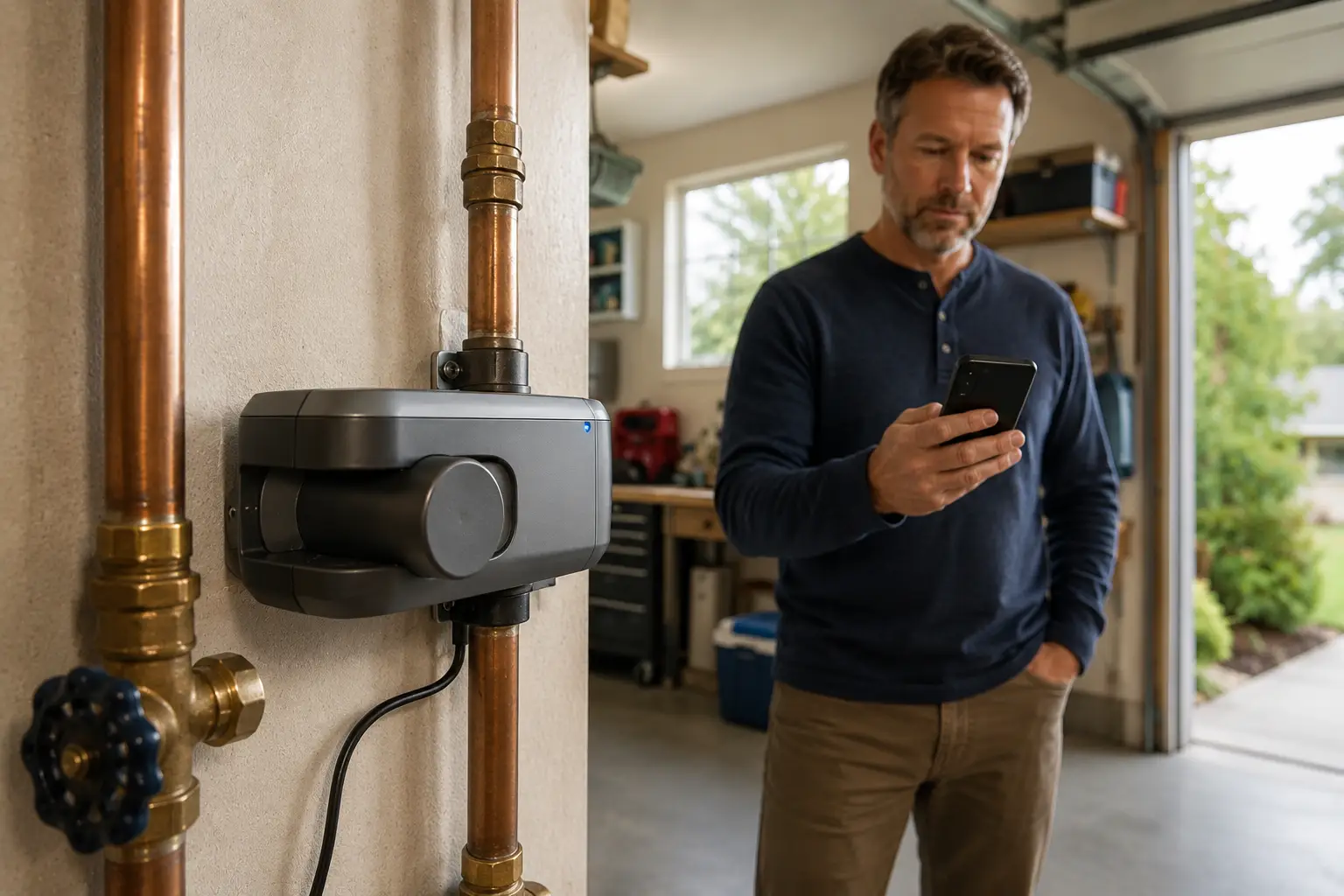
Walk down the plumbing aisle or scroll a smart-home site and you’ll find a growing category of devices promising to protect your home from water damage automatically. Moen Flo, Phyn, and a handful of others monitor your water, detect leaks, and in some cases shut the water off on their own before a small problem becomes a flooded house.
The marketing is compelling, and the promise is real. But as a company that finds leaks for a living, we get asked a fair question: are these things actually worth the money, or are they an expensive gadget? The honest answer is that smart leak detectors are genuinely useful, and they’re also frequently misunderstood. They do one job very well and a different job not at all, and knowing the difference is what decides whether one is right for your home. Here’s a straight look, without the sales pitch.
What a Smart Leak Detector Actually Does
There are really two categories of device, and they’re often confused.
Point sensors are small, inexpensive pucks you place in high-risk spots: under the sink, behind the water heater, near the washing machine. When they contact water, they sound an alarm and send an alert to your phone. That’s it. They’re cheap, easy, and only useful in the exact spot you put them.
Whole-home monitors with automatic shutoff are the more serious tool. Devices like Moen Flo and Phyn install on your main water line and continuously watch flow and pressure through the entire house. Systems like Moen’s Flo learn your home’s normal water-use patterns and can automatically shut off the water when they detect an abnormality, such as a pipe running continuously or a slow leak. Some can catch drips as slow as one drip per minute, the kind of loss that quietly feeds rot and mold for months. When these devices are worth it, this is the type that earns its keep.
The Real Case For Them
The strongest argument for a whole-home smart shutoff is simple: it addresses the single most expensive failure mode in home plumbing, which is a catastrophic leak in an empty house.
We wrote recently about leak-proofing your home before vacation, and the core risk there is that a burst supply line or failed water heater can pump thousands of gallons into a structure while nobody’s home to notice. A smart shutoff is essentially an automated version of running to the main valve. It’s watching around the clock, and it acts in seconds whether you’re asleep, at work, or on a beach in another state.
The financial logic holds up, too. The average U.S. water damage insurance claim runs around $11,000, which means a device that prevents even one significant leak event can pay for itself many times over. And there’s often an insurance incentive on top of that: many major insurers offer a premium discount, commonly in the range of 3 to 10 percent, for an approved automatic shutoff device, and some brands carry additional protections such as deductible reimbursement plans. For a homeowner who travels often, owns a second or seasonal home, or simply wants a safety net against the 2 a.m. pipe burst, that’s real value.
The Honest Limitations Nobody Advertises
Here’s the part the marketing tends to skip, and the part that matters most for setting your expectations correctly.
A smart detector tells you that water is escaping. It does not tell you where or why. A whole-home monitor knows your total flow is abnormal, so it alarms or shuts the house down. That’s excellent for stopping damage, but it can’t point to the cracked fitting in the wall, the pinhole in the slab, or the failing line in the yard. It has narrowed the problem down to “somewhere in the house,” which is a long way from the spot a repair actually happens.
It can’t see the leaks that never touch the main line the way it expects. A slow underground leak in a buried supply line before the device, an irrigation line on a separate zone, or a pool losing water through its own plumbing may not register at all, because they’re outside what the device monitors. The hidden, gradual leaks that our clients most often call us about are frequently the ones these devices are weakest at catching.
Point sensors only protect the exact inch of floor they sit on. A puck under the kitchen sink does nothing for a leak behind the shower wall or under the slab. They’re a spot solution, not whole-home coverage.
Installation and discounts often require a professional. A main-line shutoff device usually needs to be plumbed in correctly, and many insurers require proof of professional installation before they’ll honor the discount. That’s a real cost to factor in alongside the device price.
None of this makes these devices bad. It just means they’re a damage-prevention tool, not a diagnostic one.
Prevention vs. Diagnosis: Why You Likely Want Both
The clearest way to think about it is this. A smart shutoff is a smoke alarm. Professional leak detection is the inspector who finds the faulty wiring. You want the smoke alarm because it stops a disaster in progress, but when it goes off, you still need someone to find the actual cause and fix it.
When a smart device shuts your house down or flags abnormal flow, the water is off, which is exactly what you want in that moment. But the leak is still there, still unlocated, and the water has to come back on eventually. That’s the point where acoustic listening equipment, pressure testing, and thermal imaging come in to pinpoint the exact source, so the repair is small and targeted rather than exploratory. The device buys you time and prevents the flood. The detection finds the problem. They solve different halves of the same equation.
It’s also worth knowing the low-tech version of monitoring that costs nothing: your water meter. Learning to read your meter to catch a hidden leak gives you a manual version of what these devices automate, and it’s a good habit whether or not you ever buy one.
So, Are They Worth It?
For many Washington homeowners, yes, with realistic expectations. A whole-home smart shutoff is a sound investment if you travel frequently, own an older home with aging plumbing, have a finished basement or valuables that a leak would destroy, or simply value the peace of mind of automated protection. The insurance discount and the prevention of a single major claim can justify the cost on their own. Point sensors are cheap enough to be worth tossing under a few high-risk appliances regardless.
What they are not is a replacement for knowing where a leak is and fixing it. If your water bill is climbing, you hear water running with everything off, or you suspect a hidden leak in a slab, a yard line, or a pool, a device that shuts off your main won’t answer the question you actually have. It’s also worth understanding how leaks factor into coverage before you rely on any single safeguard, which we cover in our post on whether homeowners insurance covers a water leak.
Our honest recommendation: treat a smart shutoff as a valuable layer of protection, not the whole strategy. Pair it with the habit of watching your meter and bill, and with a call to a professional the moment something seems off.
When You Need the Leak Found, Not Just Stopped
Smart detectors are a genuine step forward for protecting a home, and we’re glad to see homeowners taking prevention seriously. But when a device flags a problem, or when you suspect a leak it can’t locate, finding the exact source is still a job for detection equipment and an experienced eye.
If you’re dealing with a leak you can’t pin down, a suspicious water bill, or a device telling you something’s wrong without telling you where, call Action Leak Detection at (360) 922-8829. We locate hidden leaks precisely and non-invasively for homeowners throughout King, Snohomish, Skagit, Whatcom, Island, and San Juan counties.
A smart valve can stop the water. We’ll tell you where it was going.
Action Leak Detection serves Whatcom, Skagit, Snohomish, King, Island, and San Juan counties. We answer 24/7, including weekends and holidays.