Summer in western Washington is short.
Most pool owners in King, Snohomish, Skagit, and Whatcom counties get twelve — maybe fourteen — weeks of genuinely warm weather before the rains return. That makes every single week of pool season valuable. And it makes a hidden pool leak one of the most expensive problems a Washington homeowner can face, because you don’t just lose water. You lose usable summer.
The problem is that pool leaks are easy to miss — especially early on, when they’re small enough to be mistaken for normal evaporation. By the time most pool owners confirm they have one, the leak has already been running for weeks, saturating the soil around the deck, throwing off the water chemistry, stressing the equipment, and in some cases beginning to undermine the structure itself.
Here are the five signs Washington pool owners most commonly overlook — and what each one means for your pool, your yard, and your wallet.
Why Pool Leaks Are Harder to Spot in the Pacific Northwest
Before getting to the signs, it’s worth understanding why pool leaks are particularly easy to miss in western Washington.
In hot, dry climates, pool evaporation is high and predictable. Owners develop an intuition for how much water their pool normally loses in a week, and a leak stands out because the loss is noticeably higher than that baseline.
In the Pacific Northwest, it’s different.
Our cooler summer temperatures mean evaporation rates are lower than pool owners in California or Arizona would expect. That sounds like a good thing — and it is — but it also means a slow leak can hide inside the normal variation more easily. A pool losing a quarter inch a day to a leak may not feel dramatically different from a pool losing an eighth of an inch a day to evaporation, especially if you’re not watching closely.
The Pacific Northwest’s frequent overcast days during shoulder season add to the confusion. Owners open their pools in May or June, notice the water seems low, assume it’s from a rainy spring or a splash-out during a cover removal, and don’t investigate further.
By July, the leak has been running for two months.
Sign #1: Your Water Level Is Dropping More Than Evaporation Can Explain
This is the most obvious sign — and the one most often explained away.
A pool in normal Pacific Northwest summer conditions will lose roughly ⅛ to ¼ inch of water per day to evaporation depending on temperature, wind, sun exposure, and whether you’re running a waterfall or fountain feature. That’s normal. That’s not a leak.
If your pool is losing more than ¼ inch per day, consistently, over several days of observation — that’s a problem worth investigating.
The most reliable way to tell the difference between evaporation and a leak is the bucket test:
- Fill a 5-gallon bucket with pool water and place it on your top step or on the deck next to the pool
- Mark the water level inside the bucket and on the pool wall with tape
- Let it sit for 24 to 48 hours with the pump running normally
- Compare the drop: if the pool lost significantly more water than the bucket, you have a leak
The bucket eliminates weather variables — both the pool and the bucket are exposed to the same sun, wind, and temperature. If they evaporate at the same rate, you’re fine. If the pool drops further, something is taking water away from it that isn’t the weather.
What makes this sign easy to miss in Washington: pool owners here tend to check levels less obsessively than owners in drier climates. If you’re only glancing at the pool every few days, a quarter inch of daily loss can go unnoticed for weeks before the drop becomes undeniable.
Sign #2: Your Auto-Fill Runs Constantly or Your Water Bill Has Spiked
Many pools in western Washington are equipped with an auto-fill valve that maintains water level automatically. It’s a convenience feature — and it’s one of the reasons pool leaks go undetected for so long.
If your pool has an auto-fill, it will silently compensate for a leak by adding water whenever the level drops below the set point. From the surface, the pool looks fine. The water level is normal. Nothing appears wrong.
What gives it away:
- The auto-fill valve is running at odd hours, or running more frequently than it used to during the same weather conditions
- Your water bill has increased without an obvious explanation — and the increase is consistent month over month rather than a one-time spike
- Your auto-fill runs during cool or cloudy stretches when evaporation should be minimal
A pool leaking at a modest rate can add tens of thousands of gallons of water over the course of a Pacific Northwest pool season. That water goes somewhere — into the soil beneath your deck, the landscaping around your equipment pad, or in worse cases, toward your home’s foundation.
If you have an auto-fill and you haven’t thought about it in months, that’s the time to pay attention. A meter that never seems to stop is the pool’s quiet way of telling you something is wrong.
Sign #3: Wet Spots, Soft Ground, or Dying Vegetation Around the Deck or Equipment Pad
This is the sign that tells you the leak has already been running long enough to move water into the surrounding landscape.
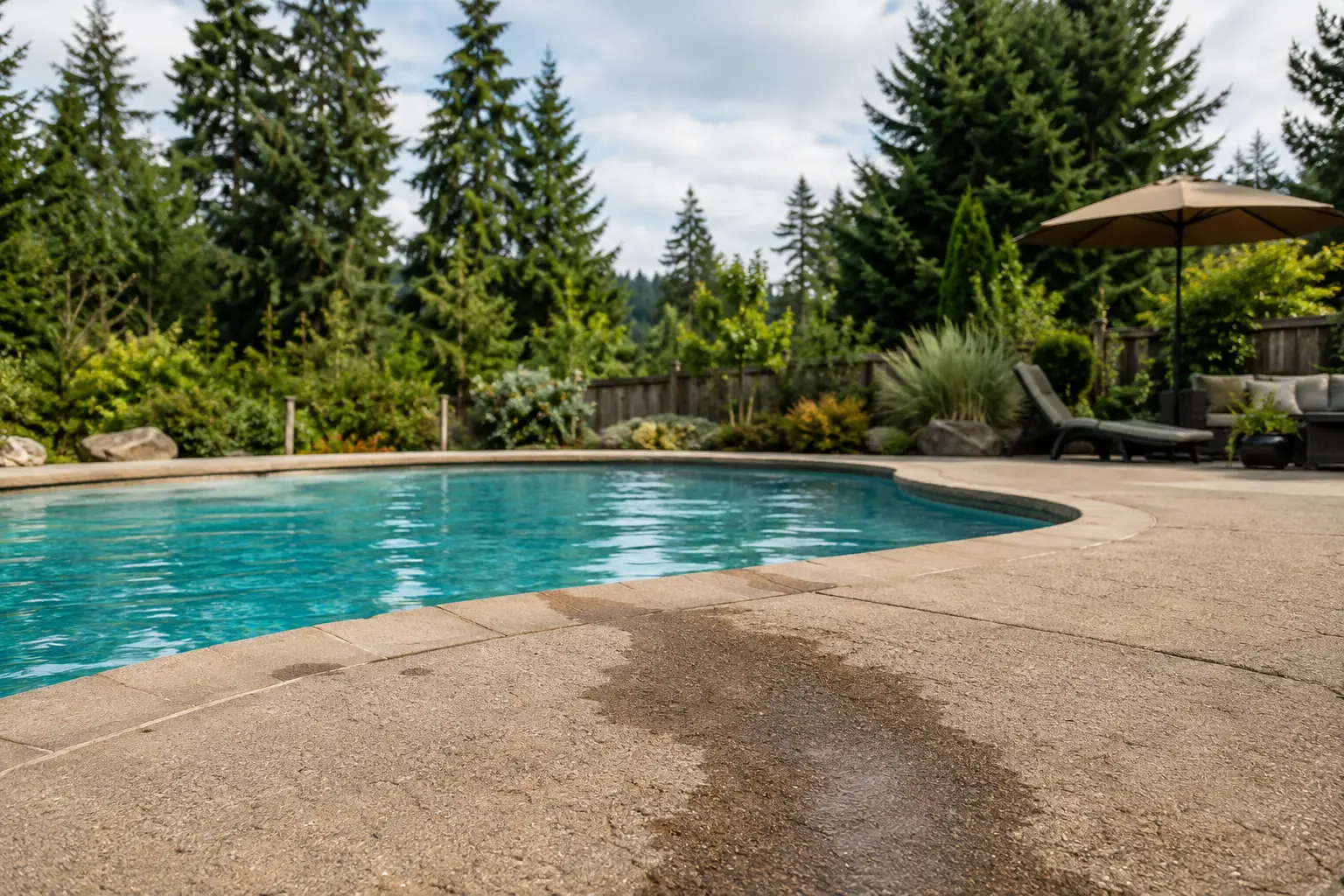
Pool leaks that originate in underground return or supply lines — the plumbing that runs between your pool, your equipment pad, and your return jets — don’t surface inside the pool. They surface in the yard, the garden bed, or the soil beneath the concrete deck. By the time you see evidence above ground, the leak has been saturating the subsurface for some time.
Watch for:
- Persistently wet or soggy ground near the equipment pad, along the pool deck edge, or in the landscaping between the pool and the house — especially during dry stretches when surrounding areas are dry
- Soft or spongy sections of concrete decking that flex when you step on them, suggesting the soil beneath has been eroded or saturated
- Cracks appearing in the concrete deck or coping that weren’t there at the start of the season — often caused by soil movement or settlement beneath the slab as water saturates and shifts the ground
- Sections of lawn or garden that are unusually green or lush directly adjacent to the pool plumbing path — plants growing over a leaking line often look noticeably healthier than surrounding vegetation
- Dead or dying grass or plants in a strip or patch near the pool — less common, but some soil types become waterlogged enough to suffocate roots rather than feed them
In western Washington, the combination of clay-rich soils in many areas and naturally high seasonal water tables means that subsurface water from a pool leak doesn’t drain away quickly. It accumulates. And accumulated water beneath a concrete deck will eventually cause that deck to move, crack, and settle.
Catching this sign early — before the deck shows visible damage — is the difference between a plumbing repair and a concrete replacement.
Sign #4: Your Pool Chemistry Won’t Stay Balanced No Matter What You Add
This one surprises most pool owners, because it doesn’t feel like a water problem. It feels like a chemistry problem.
Here’s what’s actually happening: every time your pool loses water to a leak and your auto-fill (or a garden hose) replaces it, you’re diluting the chemicals you just added. Fresh water coming in carries its own mineral content, pH level, and alkalinity — all of which interact with your existing pool chemistry. If this is happening continuously, your chemical balance will be continuously shifting, and no amount of treatment will hold it stable for long.
Specific signs this may be leak-related:
- pH and alkalinity that drift faster than normal, requiring more frequent adjustment than they did in previous summers
- Chlorine demand that seems unusually high — you’re adding the same amount you always have, but the pool is burning through it faster
- Algae blooms that keep returning despite consistent treatment, often a sign of ongoing dilution that’s keeping sanitizer levels too low to be effective
- Calcium hardness that consistently tests low, which can happen when fresh water is constantly replacing chemically treated pool water
None of these symptoms alone definitively means you have a leak — there are other explanations for chemistry issues. But when chemistry instability combines with any other sign on this list, the leak explanation becomes much more likely.
In Washington, where pool seasons are short and chemical costs add up quickly over a compressed summer window, persistently unstable chemistry that isn’t responding to treatment is worth investigating for a structural cause rather than just adding more product.
Sign #5: Air Bubbles in Your Return Jets or Equipment Working Harder Than Usual
This sign points to a specific type of pool leak — one in the suction side of your plumbing — and it’s one of the clearest indicators that the problem is underground rather than in the pool shell itself.
Your pool’s circulation system works by drawing water from the pool through the skimmer and main drain, pushing it through the filter and heater, and returning it through the return jets. The entire suction side of this system is under negative pressure — it’s pulling water, not pushing it.
When a suction-side line develops a crack or a failing joint underground, it pulls air into the system instead of water. That air travels through the pump and shows up at your return jets as a stream of bubbles — something you should never see under normal operating conditions.
Other equipment signs associated with this type of leak:
- The pump loses prime intermittently — it runs dry, cavitates, and has to restart
- The pump runs louder than usual or sounds like it’s working harder than it should
- The filter pressure gauge reads lower than normal, because the pump isn’t getting a full column of water to push
- The heater cycles on and off unexpectedly, triggered by low flow conditions caused by air in the line
Suction-side leaks are particularly damaging to pool equipment because a pump that regularly runs with air in the system will overheat, wear out faster, and eventually fail. In Washington, where pool equipment sits idle for eight or nine months of the year and then has to perform reliably during the short summer window, a pump failure in July is a significant problem.
If you’re seeing bubbles in your return jets, don’t wait to have it looked at.
What to Do If You Recognize Any of These Signs
If two or more of the above signs are present at your pool right now, there is almost certainly a leak somewhere in the system. The question is where.
Pool leaks occur in three distinct locations — and the location determines the repair:
- The pool shell — cracks or gaps in the concrete, fiberglass, or vinyl liner itself
- The fittings — where lights, return jets, skimmers, and main drains connect to the shell. These are the most common leak points in older pools
- The underground plumbing — the buried supply and return lines between the pool and the equipment pad
Finding the exact location without professional equipment is nearly impossible. Guessing — or having a pool maintenance company probe around without detection gear — risks opening up decking, digging up landscaping, or draining the pool unnecessarily, none of which solves the problem if the leak isn’t where you assumed it was.
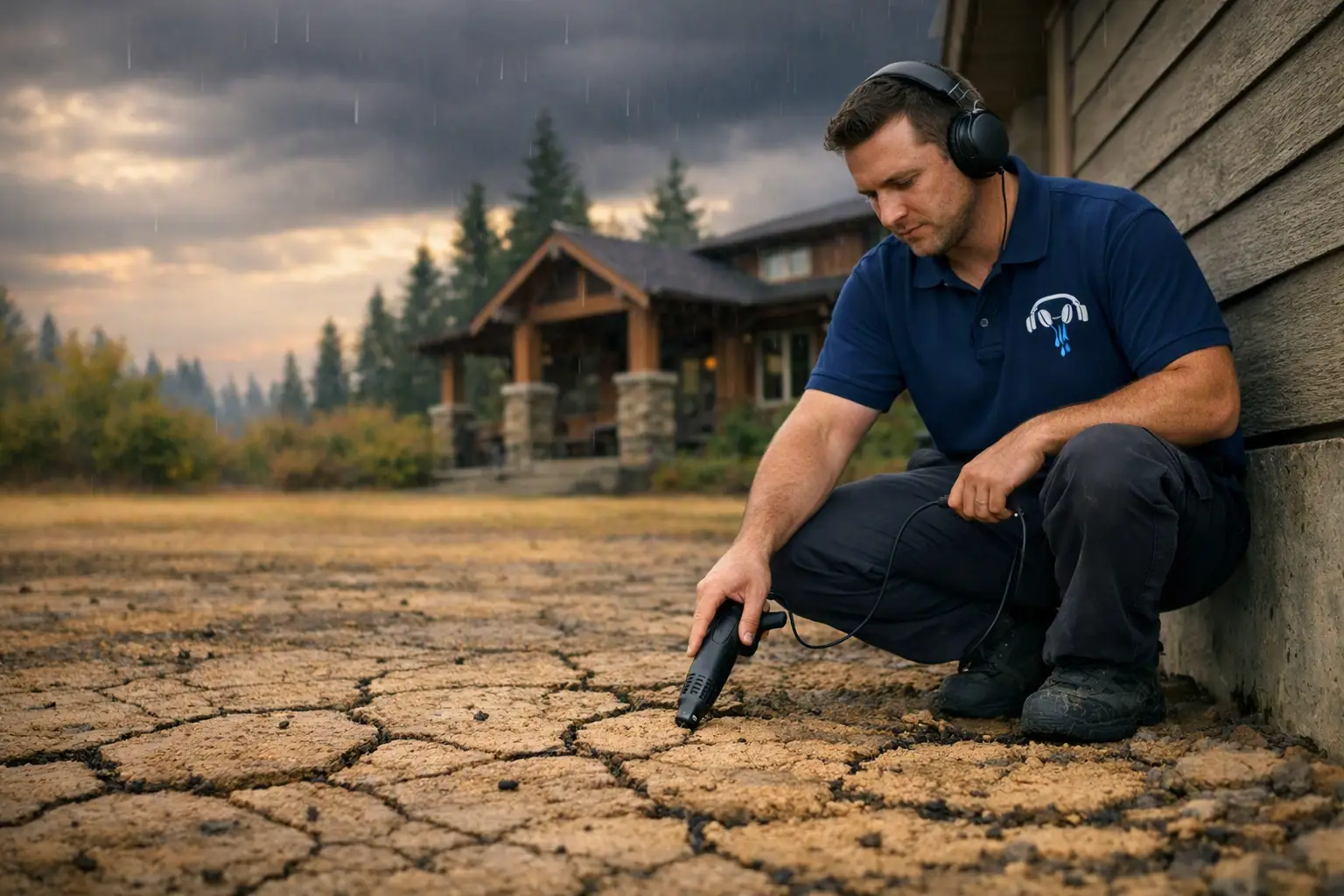
At Action Leak Detection, we use electronic leak detection equipment, pressure testing, and underwater hydrophones to locate pool leaks precisely — without draining your pool and without breaking up your deck. We pinpoint the exact source before any repair work begins, which means the repair is faster, less invasive, and less expensive than a guesswork approach.
Don’t Let a Short Summer Get Shorter
A pool leak that starts in late May and goes undiagnosed until August isn’t just a plumbing problem. It’s a lost summer — wasted water, wasted chemicals, stressed equipment, and in the worst cases, structural damage to the deck and surrounding landscape that outlasts the season itself.
The five signs above are usually present well before visible damage appears. Catching a leak at the chemistry stage or the auto-fill stage is a fundamentally different repair than catching it at the cracked deck stage.
If something about your pool this summer doesn’t feel right — the level, the chemistry, the equipment, the ground around the deck — call Action Leak Detection at (360) 922-8829.
We serve pool owners throughout King, Snohomish, Skagit, Whatcom, and Island counties with non-invasive leak detection that finds the problem accurately the first time.
Don’t lose the summer to a leak you could have caught in a day.
Action Leak Detection serves Whatcom, Skagit, Snohomish, King, Island, and San Juan counties. We answer 24/7 — including weekends and holidays.