Snohomish County is one of the fastest-growing counties in Washington State.
It’s also one of the most quietly leak-prone.
Between mid-century housing near the Boeing corridor, rapid suburban builds from the 1990s and 2000s that are now hitting their plumbing midlife, hillside terrain in Mukilteo and Edmonds, and a river valley that floods regularly, Snohomish homeowners are dealing with a combination of factors that silently stress their plumbing systems year after year.
Most don’t find out until the water bill spikes, the drywall buckles, or the crawlspace is already wet.
Here’s why Snohomish County has its own distinct leak profile—and what Everett, Marysville, Mukilteo, Lynnwood, Bothell, and Snohomish homeowners can do to catch problems before they turn into major repairs.
Why Snohomish County Is Different From the Rest of Western Washington
It’s easy to lump western Washington together when talking about water leaks. The region shares rainfall, clay soils, and aging housing stock. But the specifics matter—and Snohomish County has its own combination of infrastructure age, geography, and growth history that creates leak risks you won’t find the same way in King, Skagit, or Whatcom counties.
Five factors make Snohomish homes especially vulnerable:
- A large stock of mid-century Boeing-era housing with aging galvanized and cast-iron systems
- A wave of suburban builds from the 1990s–2000s now entering their plumbing midlife
- Hillside neighborhoods with clay soils and unstable subsurface drainage
- The Snohomish River lowlands and a recurring flood history from Marysville to Monroe
- One of the highest HOA community densities in the state, with shared infrastructure that compounds risk
Most Snohomish County homes are exposed to at least two or three of these at once.
Risk #1: Boeing-Era Housing in Everett and South Snohomish County
Everett grew up around Boeing.
The manufacturing boom of the 1940s, 1950s, and 1960s brought workers—and with them, entire neighborhoods of homes built quickly to meet demand. The Bayside, Pinehurst, Lowell, and South Everett areas are dense with housing from that era, and much of it is still running on:
- Galvanized steel supply lines corroded from the inside
- Cast iron drain stacks that have been slowly scaling and cracking for decades
- Original copper systems with failing joints and pinhole leak risk
- Older pressure regulators that no longer hold consistent pressure
These materials have a finite lifespan—and most of them are at or well past it.
The failure mode is almost always slow and invisible. Not a burst pipe, but a weeping joint inside a wall. A hairline crack in a corroded galvanized line under the slab. A drain stack that’s been seeping into the crawlspace framing for eighteen months before anyone smells mildew.
By the time a homeowner in Everett notices something is wrong, the damage has usually been spreading for a long time.
Risk #2: 1990s and 2000s Suburban Builds Hitting Midlife
Snohomish County experienced an enormous suburban expansion in the 1990s and 2000s.
Mill Creek, Bothell, Canyon Park, Mukilteo’s newer neighborhoods, Lynnwood, Silver Firs, and east Marysville all saw rapid development during this period. That housing is now between 20 and 35 years old—which puts it squarely in the window where plumbing issues start to surface. (The median construction year for Snohomish County homes is 1990, meaning the bulk of the county’s housing stock is now in exactly this age range.)
Common problems in homes of this vintage include:
- Polybutylene pipe, installed extensively in the 1980s and 1990s, which degrades from the inside and fails without warning. Many Snohomish County homes still have it.
- PVC and CPVC fittings that have been through 25+ years of thermal cycling and are developing micro-cracks at connections and elbows
- Irrigation systems that were installed with the original landscaping and have never been pressure-tested or fully inspected
- Slab-on-grade construction common in the I-5 corridor, where copper runs embedded in concrete are now showing corrosion stress
This age of construction tends to produce leaks in places that are hard to see: inside slabs, behind finished walls, under decks and hardscape that’s been built over the original irrigation lines.
Risk #3: Mukilteo Hillsides and Clay-Rich Terrain
Mukilteo, Edmonds, and the bluff neighborhoods of south Everett sit on some of the most dynamic terrain in Snohomish County.
The steep slopes above Puget Sound are composed of glacial till, clay-rich layers, and unstable subsurface geology that shifts seasonally as it absorbs and releases the county’s significant annual rainfall. Over time, that movement:
- Pushes buried supply lines out of alignment
- Creates joint stress at buried fittings
- Causes slab movement in homes built on fill near the bluff edge
- Channels drainage water along underground pipe pathways—sometimes for hundreds of feet before surfacing anywhere visible
A leak in a Mukilteo hillside home can originate twenty feet uphill and show up as a wet patch near the garage, a damp corner in the basement, or an unexplained puddle near the foundation. The source and the symptom are rarely in the same place.
That’s exactly the kind of leak that goes undiagnosed for months when homeowners rely on visual inspection alone.
Risk #4: The Snohomish River Lowlands and Flood History
The eastern and northern stretches of Snohomish County sit in the Snohomish River basin—a lowland system that includes Marysville, Snohomish city, Monroe, Stanwood, and the agricultural flats between them.
This area has a well-documented flood history. Major flood events in recent years have left a lasting mark on the plumbing systems of thousands of homes in these communities, even ones that didn’t take visible water into their living spaces.
Homes in flood-affected lowland areas commonly develop:
- Shifted or cracked buried supply lines where saturated soil moved during high-water events
- Subfloor framing damage that compressed or kinked water lines during flooding
- Septic and drainage systems that were silently overloaded and never fully recovered
- Crawlspace moisture and pipe corrosion that accelerated dramatically after repeated wet events
Homeowners in Marysville, Snohomish, Monroe, and Arlington whose properties are within a few miles of the river should treat their plumbing the way they treat their roof after a major storm: it’s been through something, and it deserves a proper look.
The water table in these areas is also naturally high—which means that even without a flood event, underground leaks in the lowlands don’t show up the way they would in drier terrain. The wet soil masks them.
Risk #5: HOA Communities and Shared Infrastructure
Snohomish County—particularly the I-5 corridor from Lynnwood through Marysville—has one of the densest concentrations of HOA-governed communities in western Washington.
Planned subdivisions, townhome clusters, and multi-family developments built in the 1990s and 2000s often share:
- Common water main taps with aging distribution lines
- Community irrigation systems that haven’t been inspected in years
- Shared drainage infrastructure under common areas and parking lots
- Underground utilities that no single homeowner is watching closely
When a leak develops in a shared system, the cost—and the liability—is rarely simple. It may affect multiple units before it’s found. It may surface in a location far removed from the source. And the question of who detected it, when, and what inspection records exist can become a real issue at the HOA board level.
If you own a home in a Snohomish County HOA community, a baseline pressure test and leak inspection is one of the smartest things you can bring to your next board meeting—both for your own property protection and as a contribution to the community’s long-term maintenance planning.
Warning Signs Snohomish County Homeowners Should Watch For
Snohomish County’s combination of rainfall, clay soil, aging housing, and high water tables means that leaks here often hide well. But they almost always leave clues.
Watch for:
- 💧 A water meter that keeps moving when all fixtures are off
- 💧 Water bills that have crept up over several months without a clear explanation
- 💧 Damp or musty smells in crawlspaces, basements, or utility rooms
- 💧 Soft flooring, warped hardwood, or peeling paint near exterior walls
- 💧 Warm spots on slab floors or unusually cold sections of a room
- 💧 Cracks in slab or interior walls you didn’t notice before
- 💧 A sump pump cycling more frequently than it used to
- 💧 Patches of yard that stay wet long after the rain has stopped
- 💧 Sections of lawn or landscaping that are noticeably greener than the surrounding area
- 💧 Sounds of water running inside walls when no fixtures are on
Any two or three of these together almost always point to a leak somewhere in the system.
What Snohomish County Homeowners Can Do About It
You don’t have to wait for visible damage before you act.
Start here:
- Read your water meter at night. Shut everything off, note the reading, come back in an hour. Any change on the dial means water is moving somewhere it shouldn’t be.
- Pull your last 12 months of water bills. A slow creeping increase—even $10 or $15 a month over time—is often the first sign of a hidden leak.
- Walk your yard during dry weather. Any patch that stays wet, stays green, or feels spongy underfoot when the rest of the yard is dry is worth investigating.
- Check your crawlspace. Look for moisture on the vapor barrier, rust stains on pipes, damp insulation, or any sign of standing water. Most Snohomish County homes have accessible crawlspaces—use them.
- Test your irrigation system before peak season. Run each zone and walk the property. Look for pressure drops, unexpected wet areas, and any heads that aren’t functioning the way they should.
- Schedule a professional leak detection inspection. Especially if your home is mid-century, sits in the lowlands, is part of an HOA community, or sits on a Mukilteo or Edmonds hillside.
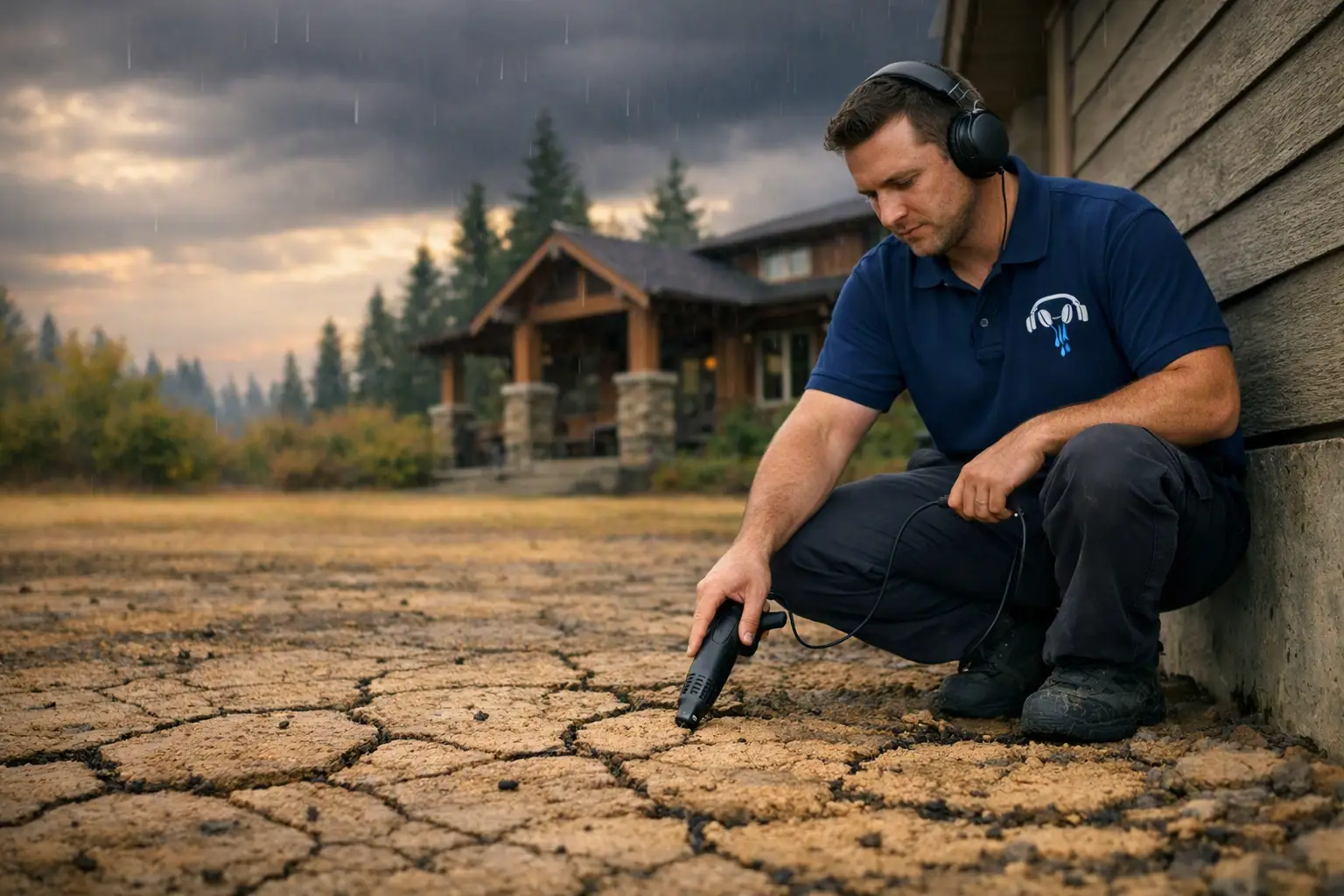
Modern leak detection is fully non-invasive. Acoustic listening equipment, thermal imaging, tracer gas, and pressure decay testing can pinpoint a leak’s exact location without breaking concrete, digging up your yard, or opening walls. In a county where landscaping, hardscape, and foundation repair are expensive, that precision saves thousands.
Don’t Let a Hidden Leak Become a Snohomish-Sized Problem
Snohomish County’s growth means more homes, more aging infrastructure, and more plumbing systems quietly approaching the point of failure.
The factors that make this county a great place to live—the established neighborhoods, the suburban communities, the lowland farms, the Puget Sound bluffs—are the same factors that create the conditions for hidden leaks to develop and hide.
Catching a leak early is almost always a small job. Missing it for a year is almost always a big one.
If you’re a homeowner in Everett, Marysville, Mukilteo, Lynnwood, Bothell, Mill Creek, Edmonds, Snohomish, Monroe, or Arlington—and something about your water usage, your yard, or your home just doesn’t feel right—call Action Leak Detection at (360) 922-8829.
We serve Snohomish County homeowners with non-invasive leak detection that finds the problem accurately the first time, without unnecessary digging, guesswork, or repeat visits.
Catch it now. Save thousands later.
Action Leak Detection serves Whatcom, Skagit, Snohomish, King, Island, and San Juan counties. We answer 24/7—including weekends and holidays.