Whatcom County is one of the most beautiful places to own a home in Washington.
It’s also one of the most challenging.
Between century-old Bellingham housing, deep winter cold snaps near the Canadian border, soggy soils, and a flood-prone river valley, Whatcom homes are exposed to a combination of conditions that quietly shorten the lifespan of plumbing systems.
The result? A surprising number of Whatcom homeowners are living with hidden water leaks they don’t yet know about—and many won’t find out until the damage costs $10,000 or more to repair.
Here’s why Whatcom County is uniquely vulnerable, and what Bellingham, Lynden, Ferndale, and rural homeowners can do to catch leaks before they get expensive.
Why Whatcom County Is Different From the Rest of Western Washington
Most leak-detection content treats western Washington as one big region. It isn’t.
Whatcom County has its own combination of climate, geology, infrastructure age, and water-system rules that don’t apply the same way in King, Snohomish, or even Skagit County.
Six factors make Whatcom homes especially leak-prone:
- A large stock of pre-1940 homes with original or aging plumbing
- Higher annual rainfall and longer wet seasons
- Deeper, longer winter freezes near the Canadian border
- The Lake Whatcom watershed and its strict water-protection rules
- A history of major flooding in the Nooksack River valley
- Hillside neighborhoods with clay soils and complicated drainage
Each one creates its own kind of leak risk. Most Whatcom homes are exposed to at least two or three of them at the same time.
Risk #1: Aging Plumbing in Older Bellingham Homes
Bellingham has one of the highest concentrations of pre-1940 housing in Washington.
The Lettered Streets, York, South Hill, Columbia, Sehome, and the Eldridge neighborhoods are full of beautiful Craftsman, Victorian, and early-20th-century homes—many of them still running on:
- Original galvanized steel supply lines
- Old copper joints with failing solder
- Cast iron drain stacks corroding from the inside
- Polybutylene pipes installed during 1980s renovations
These materials have a finite lifespan, and most of them are at or past end-of-life.
The problem is that they fail slowly.
You don’t get a dramatic burst pipe. You get a pinhole leak inside a wall. A slow drip into a crawlspace. A barely-there weep at a joint that’s been leaking for months.
By the time wet drywall, mold, or a high water bill shows up, the damage has been spreading quietly for a long time.
Risk #2: High Rainfall and Saturated Soils
Whatcom County averages 35 to 40 inches of rain per year—more in some pockets.
That much water in the ground does two things to homes:
It hides leaks.
When the soil around your house is already saturated, an underground line leak doesn’t show up as a soft spot or a green patch. It just blends into the rest of the wet yard.
It amplifies damage.
Saturated soil pushes water against your foundation, into crawlspaces, and through any vulnerable point in your plumbing. A small leak under a slab or in a buried supply line can cause far more structural damage in Whatcom than the same leak would in drier counties.
If you’ve ever had a damp crawlspace, a wet basement corner, or a sump pump that runs more than it should, you already know how much water moves under Whatcom homes.
A hidden leak in those conditions can run for months without obvious signs.
Risk #3: Cold-Snap Exposure in Lynden, Ferndale, Sumas, and Blaine
The closer you get to the Canadian border, the deeper Whatcom’s winters get.
Lynden, Sumas, Everson, Blaine, and Ferndale regularly see:
- Multi-day stretches below freezing
- Hard freezes overnight that thaw during the day
- Wind events out of the Fraser River outflow that drive deep cold into exposed pipes
This freeze-thaw cycle is brutal on plumbing.
Common cold-snap leak failures in north Whatcom homes include:
- Frozen and split hose bibs
- Crawlspace pipe ruptures
- Pressure-regulator failures
- Cracks in irrigation backflow assemblies that don’t show until spring start-up
- Slab leaks where copper has been pinched against concrete and finally cracks under expansion stress
If your home is north of Bellingham, your plumbing is taking more thermal stress every winter than a King County home—and that stress accumulates year after year.
Risk #4: Lake Whatcom Watershed and Water Quality Concerns
Most Bellingham residents are drinking water that comes from Lake Whatcom.
That’s a unique situation. Lake Whatcom is one of the most carefully regulated water sources in the state, and the watershed has strict rules about runoff, contamination, and chemical use on properties inside it.
For homeowners who live in or near the watershed—Sudden Valley, Geneva, Silver Beach, North Shore Drive, and adjacent neighborhoods—a hidden leak isn’t just a plumbing problem.
It’s a water-quality and compliance problem.
Leaks can:
- Mobilize fertilizers, fuels, or septic contamination toward the lake
- Trigger reportable conditions under watershed rules
- Affect property value and resale
- Complicate insurance and liability questions
If you own property inside the Lake Whatcom watershed, early leak detection isn’t optional—it’s part of being a responsible owner in a protected water source area.
Risk #5: Post-Flood Plumbing Damage in the Nooksack Valley
The 2021 and 2022 Nooksack River floods affected thousands of Whatcom County homes—and the plumbing damage from those events is still surfacing.
Even homes that didn’t sustain visible flood damage can have:
- Saturated subfloor framing that compressed water lines
- Buried supply lines pushed or shifted by saturated soil
- Septic and drain systems that were silently overloaded
- Crawlspace insulation hiding moisture damage that’s still spreading
Homeowners in Everson, Sumas, Nooksack, and rural Lynden who lived through those events should treat their plumbing the same way they treat their roof: it’s been through something significant, and it deserves a thorough inspection.
Risk #6: Hillside Drainage and Slab Leak Risk
Whatcom County has a lot of hillside neighborhoods.
South Hill, Edgemoor, Chuckanut Drive, Sehome, the Geneva area, and parts of Sudden Valley all sit on slopes with glacial till, clay layers, or unstable subsurface drainage.
These conditions create three specific leak risks:
- Slab leaks caused by foundation movement or settling
- Buried supply line damage from soil shifting downhill
- Drainage water that follows the path of least resistance—often along buried pipes
A leak in a hillside home can travel several feet underground before showing up at the surface, sometimes appearing well downhill from the actual problem.
That’s exactly the kind of leak DIY methods rarely find.
Warning Signs Whatcom Homeowners Should Watch For
Even with all of the above working against you, leaks usually do leave clues. The trick is knowing what to look for in a wet, forested, hilly county.
Watch for:
- A water meter that runs when nothing is being used
- Water bills that have crept up over the last 6–12 months without explanation
- Damp or musty smells in crawlspaces, basements, or closets
- Soft drywall, peeling paint, or warped flooring
- Cracks in slab floors or interior walls
- Pumps or sump pumps running more often than they used to
- Patches of yard that stay wet long after the rain has stopped
- Unusually green grass or aggressive plant growth in a single area
- Sounds of running water inside walls when nothing is on
Any one of these in isolation might be nothing. Two or three together almost always mean a leak.
What Whatcom County Homeowners Can Do About It
You don’t need to wait for visible damage to take action.
Start here:
- Read your water meter overnight. No water used, no movement on the dial, no leak. Movement of any kind means something is leaking somewhere.
- Pull last year’s bills. Compare 2025 to 2024 month by month. A creeping increase that doesn’t match your usage is a leak.
- Walk your property after a dry stretch. Any wet spot or unusually green patch when the rest of the yard is dry is worth investigating.
- Inspect your crawlspace. Look for moisture, staining, rusted clamps, and damp insulation. Most Whatcom homes have crawlspaces—use them.
- Check your hose bibs and irrigation backflow. Especially in north county homes that see deeper freezes.
- Schedule a professional leak detection inspection. Particularly if your home is older, sits on a slope, lies in a flood-affected area, or sits inside the Lake Whatcom watershed.
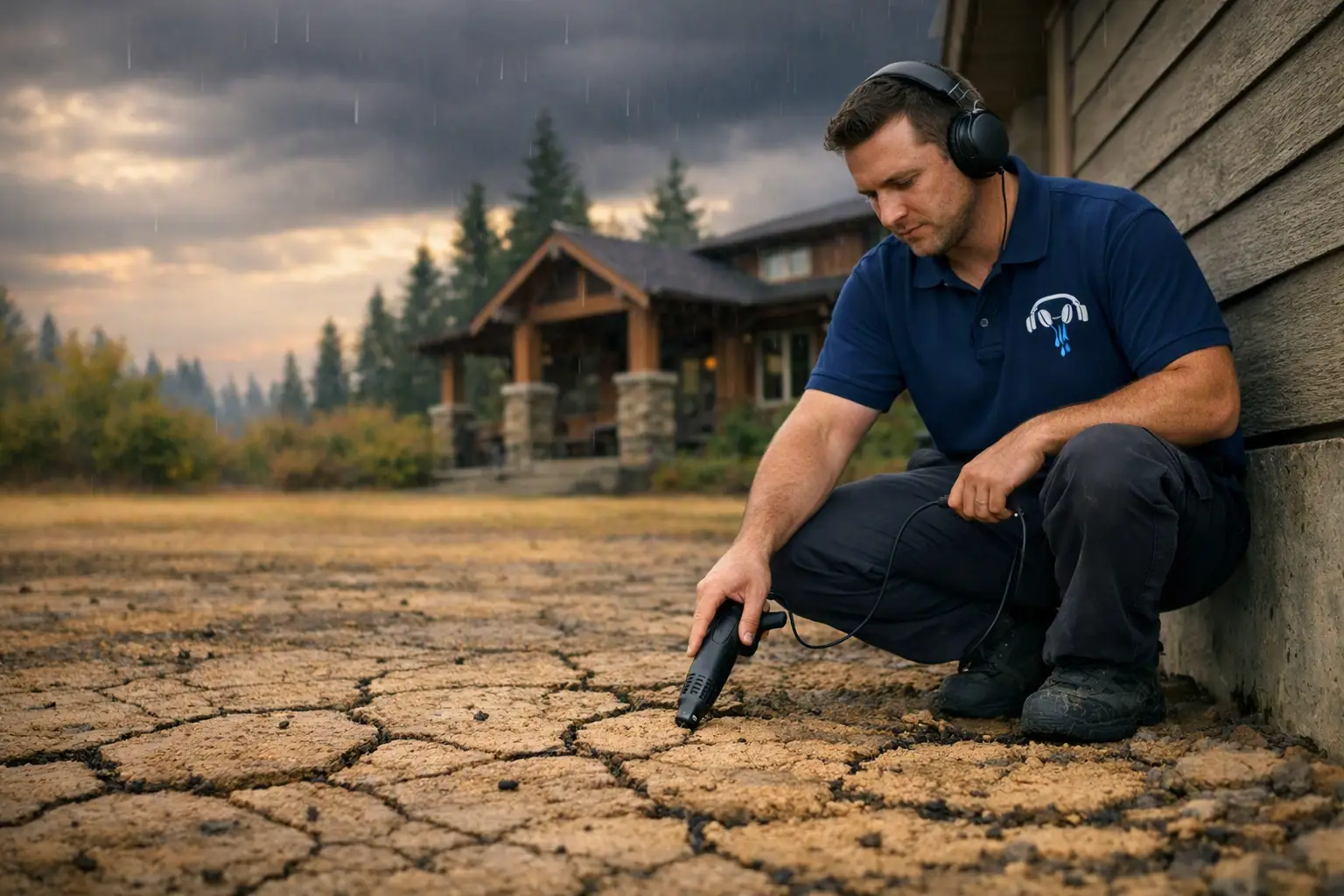
Modern leak detection is non-invasive. It uses acoustic equipment, thermal imaging, tracer gas, and pressure testing to pinpoint leaks without digging up your yard, breaking your slab, or tearing into walls.
In a county where landscaping, hardscape, and structural repairs cost more than the inspection itself, that precision is the difference between a small fix and a major project.
Don’t Let a Hidden Leak Become a Whatcom-Sized Problem
Whatcom County rewards homeowners who pay attention.
The same conditions that make this county beautiful—the rain, the slopes, the lake, the historic neighborhoods, the rural land—are the conditions that quietly accelerate plumbing failures and hide them from view.
A small investment in leak detection today is almost always cheaper than the foundation repair, drywall replacement, mold remediation, or watershed compliance issue you’ll face if a hidden leak runs unchecked for months.
If you’re a homeowner in Bellingham, Lynden, Ferndale, Blaine, Sumas, Everson, Birch Bay, Sudden Valley, or anywhere in Whatcom County and you suspect a leak—or simply want a baseline inspection—call Action Leak Detection at (360) 922-8829.
We serve Whatcom County homeowners with non-invasive leak detection that finds the problem the first time, the right way.
Catch it now. Save thousands later.