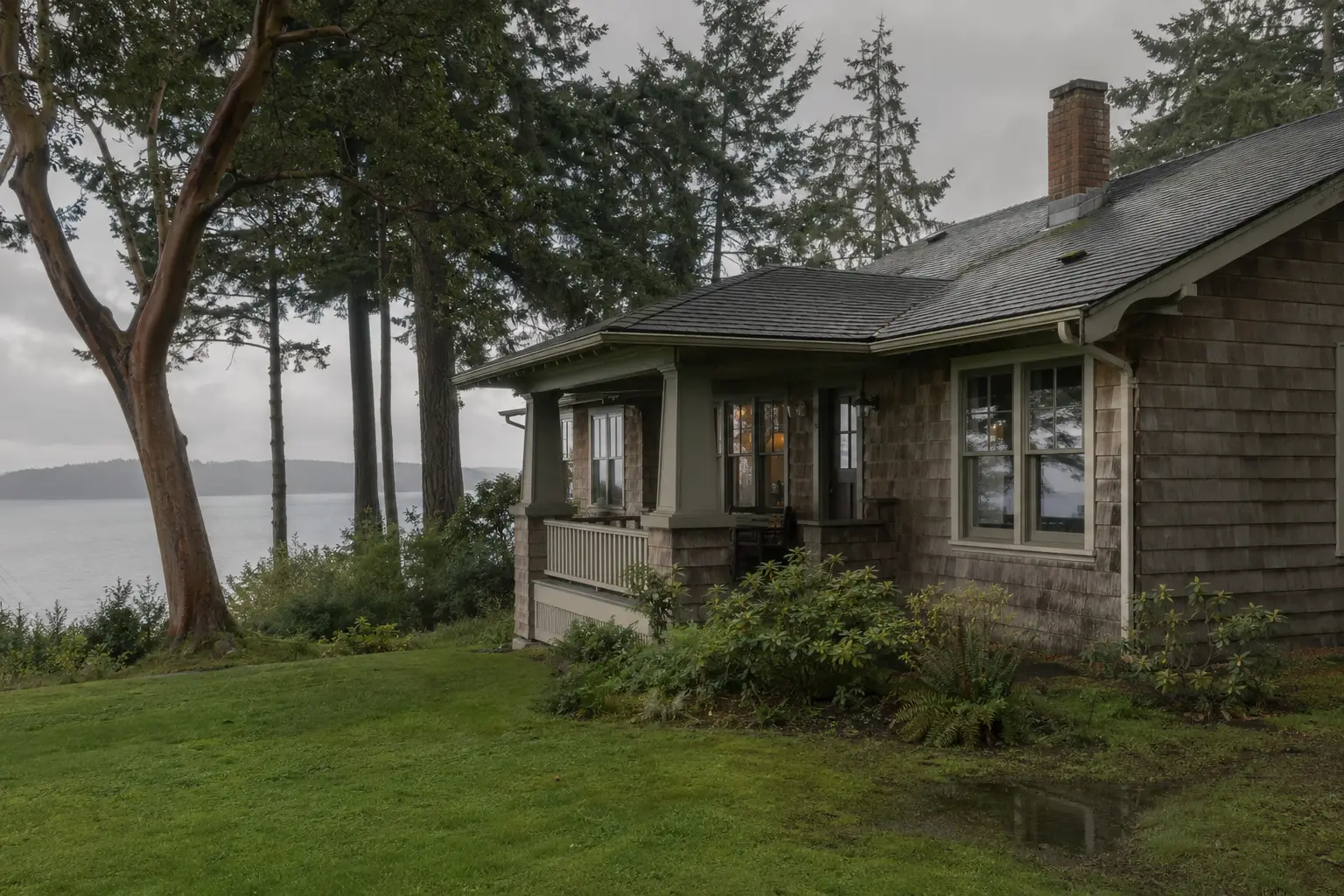
Whidbey Island is one of the most beautiful places to own a home in Washington State.
It’s also one of the most challenging when it comes to hidden water leaks.
The combination of saltwater air, older housing stock, private wells, vacant second homes, and the basic reality of island living — where getting a contractor out takes more time and costs more than it would on the mainland — means that a hidden leak on Whidbey doesn’t just damage your home. It compounds. It sits. It spreads. And by the time it surfaces, it’s almost always more expensive than it needed to be.
Here’s why Whidbey Island has its own distinct leak profile — and what Oak Harbor, Coupeville, Langley, Freeland, and Clinton homeowners can do to catch problems before they turn into major repairs.
Why Whidbey Island Is Different From the Rest of Western Washington
Most leak-detection advice treats western Washington as one region. But Whidbey Island is its own world — geographically, climatically, and in terms of how homes are built, used, and maintained.
Five factors make Whidbey homes uniquely leak-prone:
- Saltwater air that accelerates pipe and fitting corrosion far faster than inland conditions
- A large stock of older housing — including military-era homes near NAS Whidbey and century-old Craftsmans in Coupeville — with plumbing at or past end-of-life
- A high percentage of second homes and vacation properties that sit vacant for weeks or months, allowing leaks to run undetected
- Private wells and septic systems that change how leaks behave and how they’re caught
- Island logistics that make emergency plumbing and repair significantly more expensive than on the mainland
Most Whidbey homeowners are dealing with two or three of these at the same time.
Risk #1: Saltwater Air and Accelerated Corrosion
This is the factor that sets Whidbey apart from every other service area on the mainland.
Salt air is corrosive. It attacks metal surfaces continuously — not dramatically, but persistently — and it does so in ways that aren’t visible until the damage is already significant.
For Whidbey Island homeowners, this means:
- Exposed hose bibs and exterior fittings corrode from the outside in, developing pinhole leaks at threads and joints that drip into wall cavities or crawlspaces
- Copper supply lines in crawlspaces and attics develop surface pitting that accelerates over time, especially in homes close to the water in Clinton, Langley, Greenbank, and the western shoreline
- Galvanized steel pipes — still present in many older Oak Harbor and Coupeville homes — corrode from both the inside (from minerals in well water) and the outside (from salt-laden air), shortening their lifespan considerably compared to identical pipes inland
- Pressure regulators and shutoff valves in exposed or crawlspace locations seize or fail prematurely due to salt-air oxidation of their internal components
The closer your home is to the water, the more aggressive this process is. But even homes a mile or two from the shoreline are exposed to enough marine air to see meaningfully accelerated corrosion compared to a home in, say, Bothell or Mount Vernon.
Risk #2: Military-Era and Historic Housing
Whidbey Island has two distinct concentrations of aging housing stock — and both present serious plumbing risk.
Near NAS Whidbey Island in Oak Harbor, much of the surrounding residential development dates to the 1950s through 1970s, built to house the waves of Navy personnel and civilian contractors who came with the base’s expansion. These homes were built quickly, built to budget, and are now 50 to 70 years old. Many are still running on:
- Original galvanized steel supply lines well past their 40–50 year lifespan
- Cast iron drain stacks that have been scaling and cracking for decades
- Old copper systems with deteriorating solder at joints
- Pressure regulators that have never been replaced
In Coupeville, Langley, and the central island, the housing stock is even older. Coupeville is one of the oldest towns in Washington State, and the historic district and surrounding neighborhoods include homes dating to the late 1800s and early 1900s. These properties carry all of the plumbing risks of century-old construction — original or patched galvanized lines, cast iron stacks, outdated fittings — compounded by the salt-air corrosion factor described above.
In both cases, the failure mode is almost never dramatic. It’s a slow weep at a corroded joint. A hairline crack in a galvanized line that’s been thinning from the inside for years. A drain stack that’s been seeping into the subfloor framing long before anyone notices a smell.
Risk #3: Vacant Second Homes and Seasonal Properties
A significant portion of Whidbey Island’s housing stock is made up of second homes, vacation rentals, and seasonal properties — particularly in Langley, Freeland, Greenbank, and the south island communities.
These properties share a common and serious vulnerability: no one is watching.
A hidden leak that a primary homeowner might notice within days — a slightly higher water bill, a damp smell, a soft spot in the floor — can run completely undetected in a vacant property for weeks or months. By the time the owner returns or a property manager notices something, the damage has often spread through wall cavities, subfloor framing, and crawlspace insulation.
The specific risks for vacant Whidbey properties include:
- Winter freeze events that split pipes in unheated or minimally heated homes — and no one present to catch the immediate flooding
- Irrigation and outdoor systems that develop leaks during the off-season and saturate the soil around foundations unnoticed
- Water heaters that fail in vacant properties and discharge into crawlspaces or utility rooms for extended periods
- Slow slab or underground line leaks that run for an entire off-season, driving up water bills that the owner doesn’t see until they return
If you own a Whidbey Island property that sits vacant for more than a few weeks at a time, a pre-season leak inspection before you leave — and again when you return — is one of the most cost-effective things you can do to protect it.
Risk #4: Private Wells and Septic Systems
Much of Whidbey Island — particularly rural south Whidbey, Greenbank, and properties outside Oak Harbor’s municipal service area — runs on private wells and septic systems rather than municipal water and sewer.
This changes how hidden leaks behave, and how they’re caught.
With a private well, there is no monthly water bill to flag an unexpected increase. The only indication that water is being lost may be the well pump cycling more frequently than usual — a subtle sign that most homeowners don’t notice or attribute to a leak. Underground line leaks between the wellhead and the house can run indefinitely without any utility bill signal at all.
With a septic system, a hidden plumbing leak that reaches the drain field can do damage far beyond the pipe itself. Saturated drain fields fail. Replacement costs for a failed septic system on Whidbey Island — factoring in island logistics, permitting, and installation — routinely run $15,000 to $40,000 or more. A hidden leak that quietly over-saturates a drain field for months is one of the most expensive scenarios a Whidbey homeowner can face.
Additionally, many Whidbey Island properties sit in or near sensitive shoreline and wetland areas with strict Island County and Washington State Department of Ecology environmental rules. A leaking underground line that reaches a protected area can trigger regulatory involvement, remediation requirements, and liability that goes well beyond the original plumbing repair.
Risk #5: Island Logistics and the Cost of Getting It Wrong
On the mainland, if you have a plumbing emergency or a leak detection need, help is generally available quickly and at competitive rates.
On Whidbey Island, the calculus is different.
Contractors who serve the island factor in ferry time, ferry fares, and scheduling constraints that simply don’t exist on the mainland. Emergency response takes longer. Repeat visits — when a plumber makes an educated guess at a leak location rather than using professional detection equipment — are more expensive because each visit adds travel time and cost.
This is precisely why accurate leak detection matters more on Whidbey than almost anywhere else in the service area.
A plumber who opens a wall in the wrong location, or digs up a yard section that doesn’t contain the actual leak, isn’t just wasting an afternoon. On Whidbey, that mistake costs more to fix — more travel, more materials, more scheduling delay — and the leak is still running the whole time.
Non-invasive leak detection that pinpoints the exact location before any repair work begins isn’t a luxury on Whidbey Island. It’s the only approach that makes financial sense.
Warning Signs Whidbey Island Homeowners Should Watch For
Salt air, aging pipes, island humidity, and the potential for extended vacancy mean that leaks on Whidbey often hide longer than they would elsewhere. But they almost always leave clues.
Watch for:
- 💧 A well pump that cycles more frequently than it used to — especially when no water is being used
- 💧 Water bills that have increased (for homes on municipal water in Oak Harbor and parts of Coupeville)
- 💧 Rust staining or greenish patina on exterior fittings, hose bibs, and visible pipe connections
- 💧 Musty or mildew smells in crawlspaces, closets, or utility rooms
- 💧 Soft flooring, warped hardwood, or bubbling paint near exterior walls
- 💧 Warm spots on slab floors or inexplicably cold sections of a room
- 💧 Patches of yard that stay wet or unusually green after dry weather
- 💧 Cracks in interior walls or slab floors you haven’t noticed before
- 💧 Sounds of running water inside walls when nothing is on
- 💧 A septic alarm triggering more frequently — sometimes a sign of unexpected water input rather than a septic failure
For vacant or seasonal properties: walk the full exterior and crawlspace carefully at the start of every season. The earlier you find it, the smaller the repair.
What Whidbey Island Homeowners Can Do About It
You don’t have to wait for visible damage to take action.
Start here:
- Check your well pump behavior. If it’s a variable-speed pump, listen for it running at odd times when the house is quiet and nothing is drawing water. Frequent short cycles when no fixtures are in use is one of the clearest signals of a line leak on a well-fed property.
- Read your water meter if you’re on municipal water. Shut everything off, note the reading, check it in an hour. Any movement means water is going somewhere it shouldn’t.
- Inspect all exterior fittings and hose bibs. Look for rust staining, green patina, mineral deposits, or damp soil directly below any exterior connection. Salt air attacks these first.
- Walk your crawlspace. Look for moisture on the vapor barrier, rust on pipe clamps and fittings, damp or discolored insulation, and any sign of standing water. This is especially important in older homes and after any winter absence.
- Check around your water heater and pressure tank. These are common failure points in older island homes and often go unnoticed in utility closets or crawlspaces.
- Before leaving for an extended absence, turn off the main water supply or have someone check the property every two weeks. A slow leak discovered after three months of vacancy is a very different repair than one caught in the first week.
- Schedule a professional leak detection inspection — particularly if your home is older, sits near the water, runs on a private well, is left vacant seasonally, or sits in a sensitive shoreline or wetland area.
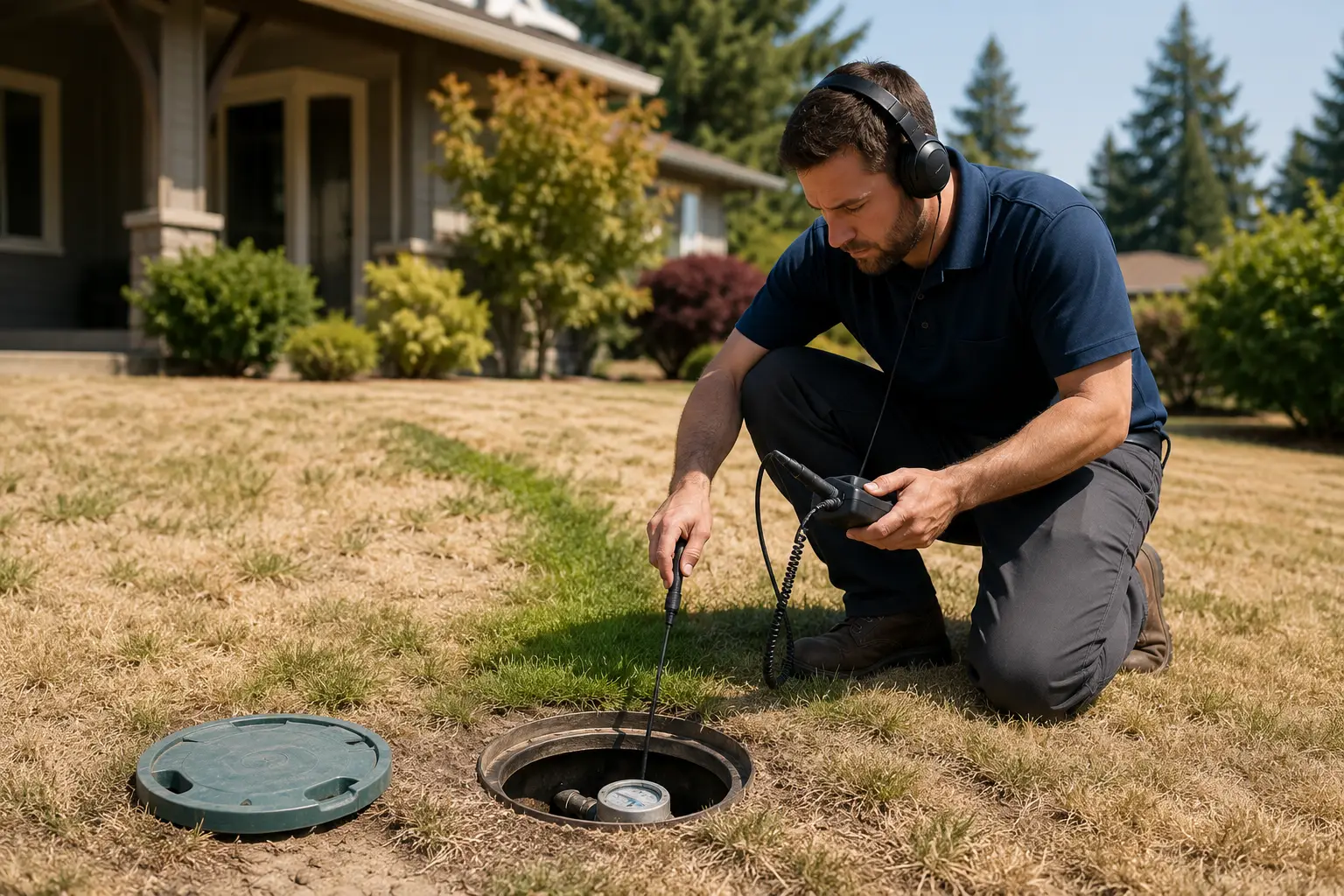
Modern leak detection is fully non-invasive. Acoustic equipment, thermal imaging, tracer gas, and pressure decay testing locate the exact source of a leak without digging, without opening walls, and without guesswork. On an island where every contractor visit costs more than it would on the mainland, that precision is the difference between a manageable repair and a project that runs well into five figures.
Don’t Let Island Life Turn a Small Leak Into a Big Problem
Whidbey Island rewards homeowners who pay attention.
The saltwater air, the aging housing, the private wells, the seasonal vacancy, and the simple reality of island logistics all mean that a hidden leak here can become a significantly more expensive problem than the same leak would be in a mainland community.
Catching it early is almost always a small job. Missing it for a season almost never is.
If you’re a homeowner in Oak Harbor, Coupeville, Langley, Freeland, Clinton, Greenbank, Bayview, or anywhere on Whidbey Island — and something about your water usage, your pump behavior, your yard, or your home just doesn’t feel right — call Action Leak Detection at (360) 922-8829, fill out our short contact form on the home page.
We serve Whidbey Island homeowners with non-invasive leak detection that finds the problem accurately the first time, without unnecessary digging, guesswork, or repeat visits.
Catch it now. Save thousands later.
Action Leak Detection serves Whatcom, Skagit, Snohomish, King, Island, and San Juan counties. We answer 24/7 — including weekends and holidays.